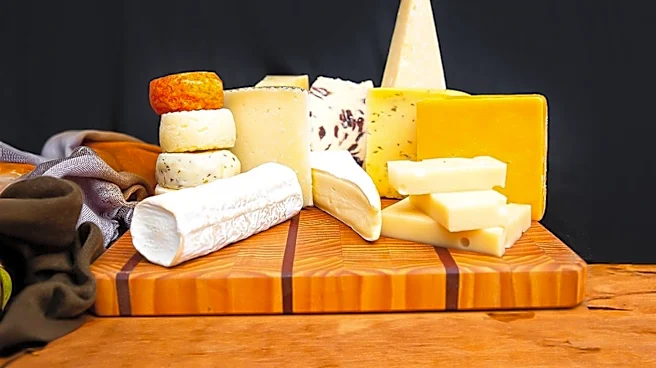









Cheddar cheese, a staple in many households, undergoes a meticulous and multi-step production process that transforms simple cow's milk into the firm, flavorful cheese we recognize. Originating from the village of Cheddar in Somerset, England, the manufacturing technique has been refined over centuries, with a key step known as "cheddaring" being central to its distinctive characteristics. This process not only reduces moisture and adjusts acidity
but also contributes significantly to the cheese's texture and taste, making it a unique and widely appreciated dairy product.
The journey of Cheddar cheese begins with milk, typically raw milk, which can be whole or 3.3% fat. Before rennet is added, the milk must be "ripened." This crucial step involves allowing lactic acid bacteria (LAB) to convert lactose into lactic acid, which lowers the pH of the milk. This reduction in pH is vital as it greatly aids in the coagulation of milk proteins, forming the curds that are the foundation of Cheddar cheese. The careful control of this initial stage sets the groundwork for the subsequent steps in the cheesemaking process.
The Role of Rennet and Curd Formation
Rennet, an enzyme originally sourced from the stomach of milk-fed calves, is essential for coagulating milk proteins. Approximately 85 to 115 grams (3 to 4 ounces) of rennet are added per 450 kilograms (1,000 pounds) of milk mix. After addition, the rennet is thoroughly mixed to ensure even distribution, often diluted with pure water to maintain its effectiveness, as any pH deviation from neutral or the presence of chlorine can rapidly decrease its potency. This coagulation process is critical for forming the solid curds necessary for cheese production.
Once the rennet is added, the mixture is allowed to set, typically for 30 to 40 minutes, at a temperature between 29 to 31 degrees Celsius (84 to 88 degrees Fahrenheit). This temperature is precisely controlled by circulating warm water through the jacketed walls of the vat. The readiness of the curd is determined by a simple yet effective test: inserting a flat blade at a 45-degree angle and slowly raising it. If the curd breaks cleanly, leaving a "glassy fracture," it is ready for the next stage. In larger facilities, a viscometer might be used for this assessment.
Cutting, Cooking, and Draining the Curds
Following setting, the curd is cut into small cubes, ranging from 6 to 16 millimeters (1/4 to 5/8 inches), using stainless steel wire knives. The size of these cubes directly influences the final moisture content of the cheese; smaller cubes result in lower moisture, while larger ones lead to higher moisture. Clean and efficient cutting is paramount to minimize the loss of fat and protein into the whey, with an optimal whey fat content of 0.3% or less. After cutting, the curds are gently handled and allowed to set again for 10 to 15 minutes to prevent excessive loss of solids.
The curds are then cooked by introducing hot water into the vat's jacket, raising the temperature to about 39 degrees Celsius (102 degrees Fahrenheit). During this 20 to 60-minute cooking phase, the curds are continuously stirred to ensure even cooking and prevent overcooking. By the end of this step, the whey's pH typically falls between 6.1 and 6.4. After cooking, the whey is drained from the curds. A gate in the vat prevents curds from escaping, and once most of the whey is removed, the curds are raked to the sides, allowing any remaining whey to drain down the middle.
The Unique Process of Cheddaring
Cheddaring is the signature process in Cheddar cheese production. It involves stacking "loaves" of curd on top of one another to press out additional whey. This multi-step technique is crucial for reducing whey content, adjusting acidity, developing characteristic flavor, and achieving a denser, sometimes crumbly texture. The curds are allowed to set until they reach a pH of about 6.4 before being cut into "loaves" approximately 15 centimeters (6 inches) wide along each side of the vat.
Every ten minutes, these loaves are turned over and stacked. Initially, two loaves are stacked together. With each subsequent turn, the stacks grow, with two stacks of two being combined. This stacking continues until the stacks are about four loaves high. While stacking stops at this point, the loaves are still turned every ten minutes. This process is carefully monitored, and it is complete when the acidity of the whey reaches between 5.1 and 5.3. Once cheddaring is finished, the large matted curds are cut into smaller pieces, about 1.3 centimeters (1/2 inch), using a milling machine. These milled curds are constantly stirred to prevent them from re-matting.
Salting, Packaging, and Aging
After milling, salt is added to the curds. The amount of salt varies but typically ranges between 1% and 3% by weight. Thorough mixing of the salt is essential. Salt plays several vital roles: it helps remove additional whey, further lowering the moisture content; it contributes significantly to the cheese's flavor; and it prevents the cheese from becoming too acidic, which could impart a bitter taste. The precise balance of salting is critical for the final product's quality.
Finally, the salted curds are placed into molds, which are then pressed to form the characteristic blocks of Cheddar. This pressing compacts the curds and gives the cheese its final shape. After packaging and pressing, the Cheddar cheese is ready for aging. Aging is a period during which the cheese develops its full flavor and texture, ranging from mild to extra mature or vintage, depending on the desired characteristics. Traditionally, Cheddar was often packaged in larded cloth, which allowed the cheese to "breathe" while protecting it from contaminants, though black wax was also sometimes used.