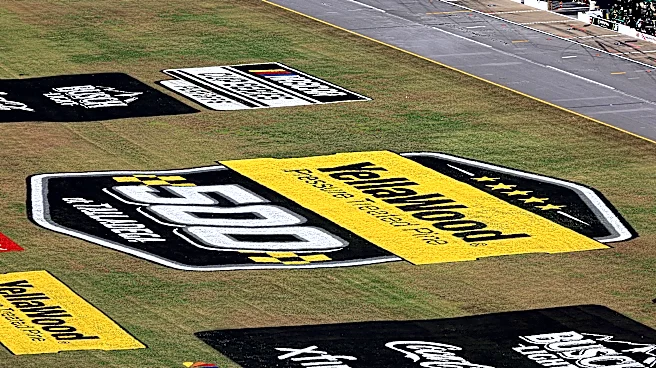



The 1985 NASCAR Winston Cup Series season was marked by the extraordinary performance of Bill Elliott, particularly his pursuit of the inaugural Winston Million bonus. The Winston 500, held on May 5, 1985, at the Alabama International Motor Speedway in Talladega, Alabama, was a pivotal event in this quest. As the ninth race of the 28-race season, it followed Elliott's victory at the Daytona 500, which was the first leg of the Winston Million promotion.
His commanding win at Talladega further solidified his dominant early-season form and set the stage for what would become a historic year in stock car racing.
Setting Records at Talladega
Bill Elliott arrived at the 1985 Winston 500 having already established himself as a formidable competitor. He secured the pole position for the race with a then-track record speed of 209.398 miles per hour in his Ford Thunderbird. This blistering qualifying speed underscored the raw power and aerodynamic efficiency of his Melling Racing machine. The race itself saw 40 drivers qualify, though one, Greg Sacks, withdrew due to an engine issue. The event was held under favorable conditions, with temperatures around 81 degrees Fahrenheit and light winds, allowing for high-speed competition.
Elliott's dominance extended beyond qualifying into the race itself. He went on to win the Winston 500, beating Kyle Petty by nearly two seconds. His average speed for the race was a record-setting 186.288 miles per hour, a mark that stood until the 1997 Winston 500. This victory was not just a testament to Elliott's driving skill but also to the performance of his Ford Thunderbird, which, along with other Fords, secured the top three positions in the race. Kyle Petty finished second, and Cale Yarborough took third in a photo finish with Petty, making them the only drivers to finish on the lead lap.
Overcoming Adversity and Competitor Concerns
Despite his commanding performance, Elliott's race was not without its challenges. Early in the event, a broken oil fitting caused him to fall nearly two laps behind the leaders. However, demonstrating remarkable resilience and speed, Elliott returned to the track and consistently ran laps near 205 mph. He managed to make up the lost two laps without the aid of a yellow flag or drafting assistance, a feat that highlighted his car's exceptional pace and his driving prowess. This comeback further cemented his reputation as a force to be reckoned with.
Elliott's dominance also sparked discussions among his competitors. Drivers like Bobby Allison and Darrell Waltrip voiced concerns about the difficulty of drafting off the back of the 1985 Ford Thunderbirds, and specifically Elliott's car. They suggested that the unique shape of the rear of the Thunderbird made it challenging for other drivers to effectively draft, contributing to Elliott's ability to pull away from the field. This observation underscored the aerodynamic advantages Elliott's team had developed, which played a crucial role in his success throughout the season.
The Winston Million and Season Implications
The 1985 Winston 500 was a critical step for Bill Elliott in his pursuit of the Winston Million, a special bonus awarded to any driver who could win three of NASCAR's four crown jewel races: the Daytona 500, the Winston 500, the Coca-Cola 600, and the Southern 500. Having already won the Daytona 500, his victory at Talladega meant he had secured two of the required three wins. Later in the season, Elliott would go on to win the Southern 500, becoming the first and only winner of the Winston Million. This achievement cemented his place in NASCAR history and made the 1985 season one of the most memorable for the sport.
The race itself was relatively clean, with only two caution periods lasting for a total of eight laps, allowing for 28 lead changes among the competitors. Over 100,000 spectators witnessed the event, which lasted just over two and a half hours. While Elliott celebrated his victory, other drivers faced different outcomes; Geoff Bodine lost the championship points lead to Terry Labonte, and for Bosco Lowe and Dick Skillen, this race marked their final NASCAR appearances. The 1985 Winston 500 remains a significant chapter in the story of Bill Elliott's legendary career and the broader history of NASCAR.