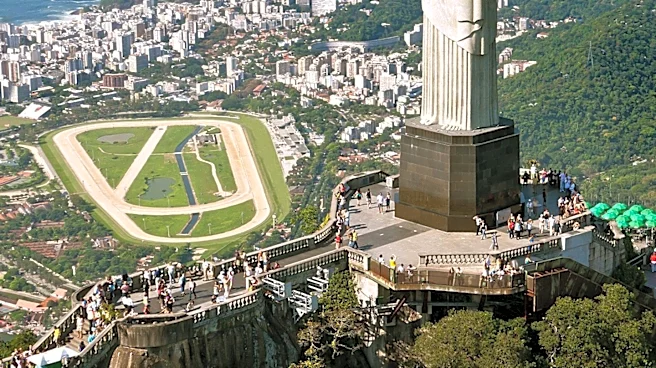



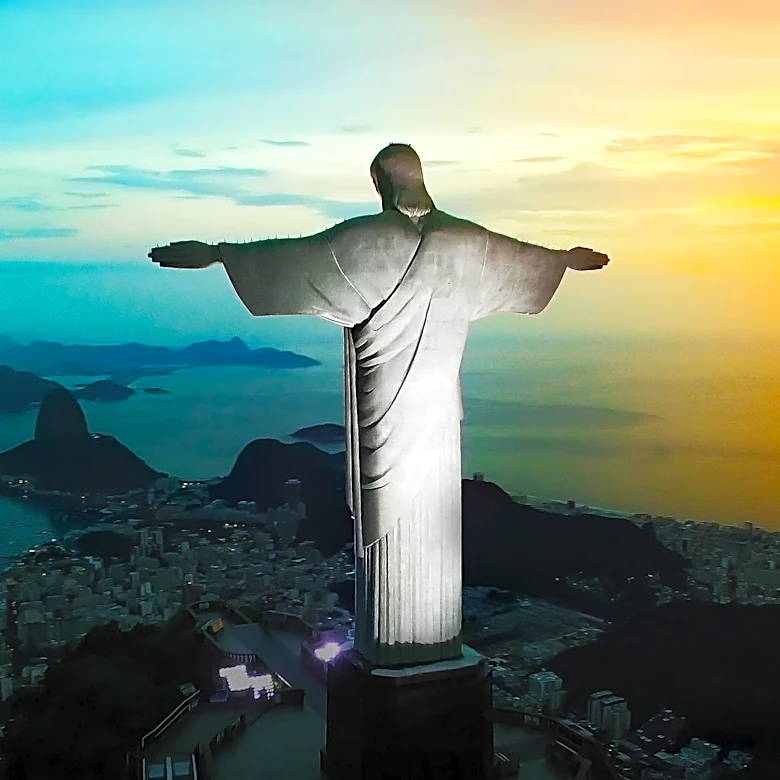




The iconic Christ the Redeemer statue, an Art Deco masterpiece overlooking Rio de Janeiro, Brazil, stands as a testament to both profound religious conviction and remarkable engineering ingenuity. Its journey from a conceptual idea in the mid-19th century to a completed monument in 1931 involved several proposals, a significant fundraising effort, and the collaborative work of international sculptors and engineers. This colossal statue, with its arms
stretching 28 meters wide, is not only a symbol of peace but also a marvel of construction, built with reinforced concrete and soapstone on the challenging terrain of Mount Corcovado.
Early Visions and Renewed Efforts
The initial idea for a Christian monument on Mount Corcovado emerged in the mid-1850s, proposed by Vincentian priest Pedro Maria Boss. His vision was to honor Princess Isabel, the regent of Brazil and daughter of Emperor Pedro II. However, this early project did not receive approval. The concept was set aside for decades, especially after Brazil became a republic in 1889, leading to the separation of church and state, which further dismissed the notion of a state-sponsored religious statue.
It wasn't until 1920 that the idea was revived by the Catholic Circle of Rio. This group launched a second, more determined proposal for a landmark statue on the mountain. They organized an event called "Semana do Monumento" (Monument Week) to gather donations and signatures, driven by a concern over what they perceived as a growing "Godlessness" in society. The fundraising efforts were largely successful, with most donations coming from Brazilian Catholics, demonstrating a strong public desire for such a symbol.
Design Evolution and International Collaboration
During the planning stages, several designs for the "Statue of the Christ" were considered. These included a representation of the Christian cross, a statue of Jesus holding a globe in his hands, and a pedestal designed to symbolize the world. Ultimately, the design chosen was the now-famous statue of Christ the Redeemer with open arms, a powerful symbol universally recognized for peace. This final design was a collaborative effort, with local engineer Heitor da Silva Costa and artist Carlos Oswald contributing to its conception.
French sculptor Paul Landowski was commissioned to create the work. In 1922, Landowski further enlisted the talents of fellow Parisian Romanian sculptor Gheorghe Leonida, who had studied sculpture extensively in Bucharest and Italy, to sculpt the face of the statue. This international team brought diverse expertise to the project, ensuring both artistic vision and structural integrity.
Construction and Material Choices
The construction phase, spanning nine years from 1922 to 1931, presented significant engineering challenges, particularly given the statue's location on a mountain peak. A group of engineers and technicians meticulously studied Landowski's submissions. They concluded that building the structure out of reinforced concrete, rather than steel, would be more suitable for the statue's cross-shaped form. This crucial design decision was made by French engineer Albert Caquot, who specialized in reinforced concrete structures.
The concrete used for the base of the statue was sourced from Limhamn, Sweden, highlighting the global nature of the project's material procurement. For the outer layers, soapstone was selected. This material was chosen for its enduring qualities, resistance to the elements, and ease of use in carving and application. The construction cost the equivalent of US$250,000 at the time, which translates to approximately $4,500,000 in 2025. The monument officially opened on October 12, 1931, marking the culmination of decades of planning and years of dedicated construction.
Opening Ceremony and Subsequent Events
The opening ceremony in 1931 was planned to be a grand affair, with an ambitious scheme to light the statue remotely. Italian shortwave radio inventor Guglielmo Marconi, stationed 9,200 kilometers away in Rome, was intended to activate a battery of floodlights. However, due to adverse weather conditions, the lights ultimately had to be activated on site. Despite this minor setback, the statue immediately became a prominent landmark.
Over the decades, the statue has required maintenance and restoration due to its exposure to the elements. Lightning strikes have caused damage on multiple occasions, notably in February 2008 and January 2014, affecting fingers, the head, and eyebrows. Restoration efforts have included replacing outer soapstone layers and repairing lightning rods. A major restoration began in 2010, involving cleaning, replacing mortar and soapstone, restoring internal iron structures, and waterproofing. This ongoing care ensures that Christ the Redeemer continues to stand as a powerful and enduring symbol.