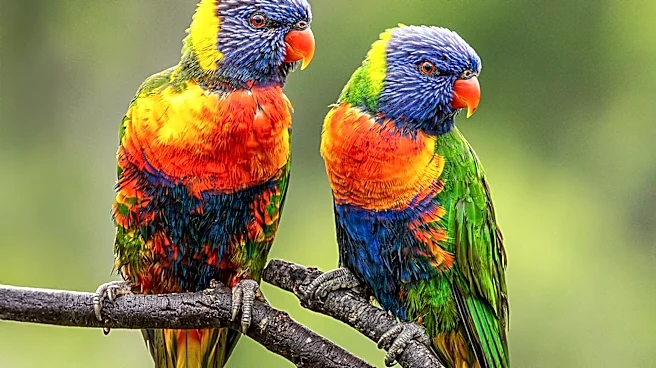







Australia is home to a fascinating array of lorikeet species, each possessing distinct characteristics that allow them to thrive in various ecological niches. While the rainbow lorikeet is perhaps the most widely recognized, other species like the musk lorikeet, red-collared lorikeet, and scaly-breasted lorikeet contribute to the rich avian biodiversity of the continent. These birds, often grouped under the genus *Trichoglossus* or related genera,
showcase a spectrum of colors, sizes, and behaviors, making them a captivating subject for ornithological study and appreciation. Their adaptations to different environments, from woodlands to urban settings, highlight their resilience and evolutionary success.
The Musk Lorikeet: An Urban Adapter
The musk lorikeet (*Trichoglossus concinnus*) is a species of parrot found in south-central and eastern Australia. This bird measures about 8.7 inches (22 centimeters) in length and is predominantly green. It is distinguished by its red forehead, a blue crown, and a noticeable yellow band on its wing. Both the upper and lower mandibles of its beak are red at the tip, gradually darkening towards the base. Musk lorikeets inhabit woodlands and drier forests in southeastern mainland Australia, primarily west of the Great Dividing Range, and are also found in Tasmania. They are considered uncommon nomads in these areas.
Musk lorikeets have demonstrated a remarkable ability to adapt to rapid urbanization. Over the past three decades, flocks of these birds have increasingly adopted Australian cities like Melbourne and Sydney as their homes. This move is partly attributed to the widespread planting of nectar-producing plants in urban areas. As nectarivores, musk lorikeets have evolved to consume nectar as a primary food source, foraging in the blooming canopies of eucalyptus forests. City plants, being regularly maintained, offer a more reliable food source compared to their natural habitats. While they prefer outer urban areas where nectar plants are denser, providing more feeding and roosting opportunities, they are also sighted in inner-city regions, albeit in smaller numbers due to reduced vegetation. This adaptability allows them to coexist with other nectarivores, such as the rainbow lorikeet, though competition for resources can arise.
The Red-Collared and Scaly-Breasted Lorikeets
The red-collared lorikeet (*Trichoglossus rubritorquis*) is another Australian species, measuring approximately 10 inches (26 centimeters) long. Its head and throat feathers are dark brown with blue shafts, and it features a distinctive orange-red band on the back of its neck. The chest is orange with red, and the base of the hindneck is dark blue. Its wings are green, and it has a red bill with grey-brown legs and feet. This species can be differentiated from the rainbow lorikeet by its green rather than red nape, the absence of a blue mantle, and more yellow-green underparts. The red-collared lorikeet is distributed across northern Australia, from King Sound in Western Australia to the Gulf of Carpentaria, inhabiting woodland, open forest, and rainforest, and has successfully adapted to urban environments.
Meanwhile, the scaly-breasted lorikeet (*Trichoglossus chlorolepidotus*) is aptly named for its unique appearance. This Australian lorikeet, found in eastern Australia, has yellow breast feathers broadly edged with green, creating a scaly effect. It measures about 9.1 inches (23 cm) long. Its crown and head sides are emerald-green with a slight blue tinge, while the throat and breast feathers are yellow with broad green edges. The tail is green, with orange-red markings at the base of the outer tail-feathers. These birds are common in most timbered areas of Eastern Australia, from North Queensland to the New South Wales south coast, favoring open, lightly timbered areas and melaleuca thickets. They are known for their extremely noisy calls, including a metallic, rolling screech in flight and a shrill chatter when feeding.