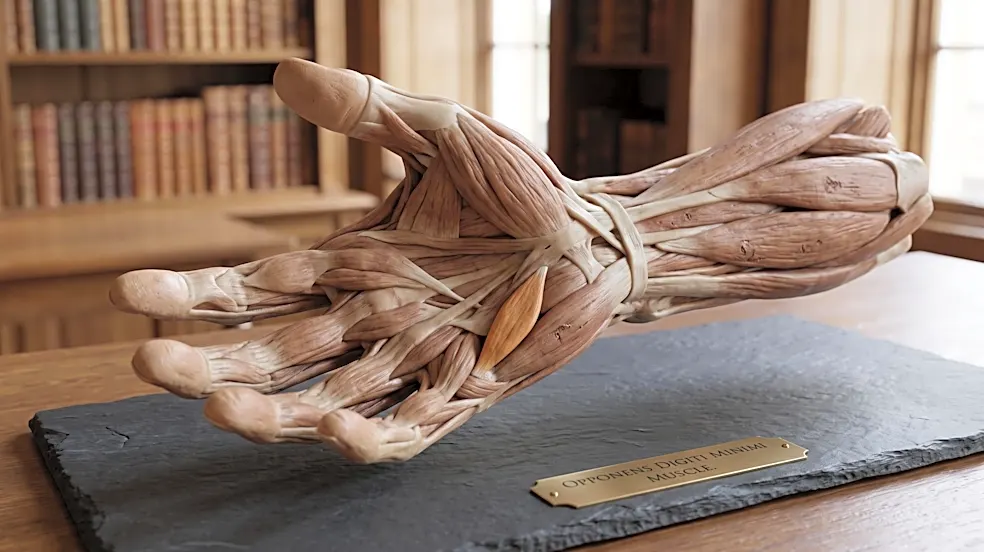








The opponens digiti minimi, often referred to as the "little finger opposer," is a triangular-shaped muscle located within the hand. It forms a crucial part of the hypothenar compartment, which is the fleshy mound at the base of the little finger. This muscle plays a specific role in the movement and dexterity of the little finger, contributing to the overall functionality of the human hand. Its unique structure and innervation allow for precise actions,
particularly in conjunction with other hand muscles.
Anatomical Structure and Location
This muscle's journey begins with its origin points: the hook of the hamate bone and the flexor retinaculum. The hamate bone is one of the eight carpal bones in the wrist, and its distinctive hook provides an anchor for several hand muscles. The flexor retinaculum, a strong fibrous band across the front of the wrist, also serves as an important attachment site. From these origins, the opponens digiti minimi extends to insert into the medial border of the 5th metacarpal bone, which is the long bone within the hand that connects to the little finger.
Its triangular shape allows it to exert force efficiently across the 5th metacarpal. The muscle is situated immediately beneath other muscles of the hypothenar eminence, specifically the palmaris brevis, the abductor digiti minimi, and the flexor digiti minimi brevis. This deep positioning highlights its role in providing foundational movement for the little finger, rather than superficial actions.
Function and Movement of the Little Finger
Despite its name, which translates to "little finger opposer," the opponens digiti minimi's ability to truly oppose the little finger in humans is quite limited. However, its primary function involves flexing and laterally rotating the 5th metacarpal bone. This action is critical for bringing the little finger into a position where its tip can make contact with the thumb, a movement essential for grasping and manipulating objects.
Working in concert with the opponens pollicis, the muscle responsible for thumb opposition, the opponens digiti minimi contributes to the deepening of the palm, a movement sometimes described as a "water-scooping" action. This combined effort is vital for creating a cupped hand shape, which is necessary for holding various items securely. The muscle's contribution to hand dexterity is therefore significant, even if its direct opposition capability is less pronounced than its name suggests.
Innervation and Comparative Anatomy
The opponens digiti minimi receives its nerve supply from the deep branch of the ulnar nerve. This nerve is crucial for controlling many of the intrinsic muscles of the hand, particularly those involved in fine motor skills and grip strength. The ulnar nerve's deep branch ensures that the signals from the central nervous system effectively reach the opponens digiti minimi, allowing for coordinated movement of the little finger.
Interestingly, this specific muscle is not found in domestic animals. This anatomical distinction underscores a unique aspect of human hand anatomy, suggesting its specialized role in the complex manipulative capabilities that differentiate human hands. The presence and function of the opponens digiti minimi in humans highlight an evolutionary adaptation for enhanced dexterity and precision in hand movements.