








Cancún, a city now synonymous with vibrant tourism on Mexico's Yucatán Peninsula, has a relatively short but dramatic history as a major international destination. Before the 1970s, this area was largely undeveloped, a stark contrast to its current status as a bustling resort city. Its transformation was not accidental but the result of a deliberate government initiative aimed at creating a new recreational zone in Mexico, ultimately turning a quiet
island into one of the country's most recognized resorts.
The Genesis of a Tourist Destination
The idea to develop Cancún into a tourist hub began to take shape in the late 1960s. In 1967, the Mexican government allocated a significant fund of 2 million dollars, to be managed by the Bank of Mexico, to explore the feasibility of establishing new recreational areas. The directive was to identify locations where viable development alternatives were scarce, making the creation of a tourism center a primary economic driver. This task was entrusted to INFRATUR, an agency under the Bank of Mexico, which played a pivotal role in the initial planning and execution of the Cancún project.
At the time development commenced on January 23, 1970, Isla Cancún was far from a bustling center. It was home to only three residents, who served as caretakers for the coconut plantation owned by Don José de Jesús Lima Gutiérrez. These caretakers resided on Isla Mujeres, indicating the sparse population and undeveloped nature of the area. Nearby, Puerto Juárez, a fishing village and military base, had a slightly larger population of about 117 people. This humble beginning underscores the ambitious vision behind Cancún's creation.
Overcoming Initial Skepticism and Rapid Growth
Despite the government's vision, there was initial reluctance from private investors to commit to an unknown area. To overcome this skepticism and kickstart the project, the Mexican federal government took the initiative to finance the construction of the first nine hotels. This crucial investment demonstrated confidence in the project and paved the way for future private sector involvement. Cancún officially began as a tourism project in 1974, designated as an Integrally Planned Center, a pioneering effort by FONATUR (National Fund for Tourism Development), formerly INFRATUR.
From its inception, Cancún experienced rapid and sustained growth. The city underwent a comprehensive transformation from what was essentially a fisherman's island into one of Mexico's two most well-known resorts, alongside Acapulco. The population growth in Cancún significantly outpaced the rest of Quintana Roo during the late 20th century. Between 1970 and 1980, the city's population grew by an average of 62.3% annually, a testament to the success of the development project. This growth exceeded the expectations of Mexican state planners, solidifying Cancún's role as a major economic engine for the region.
Modern Cancún: A Diverse and Evolving City
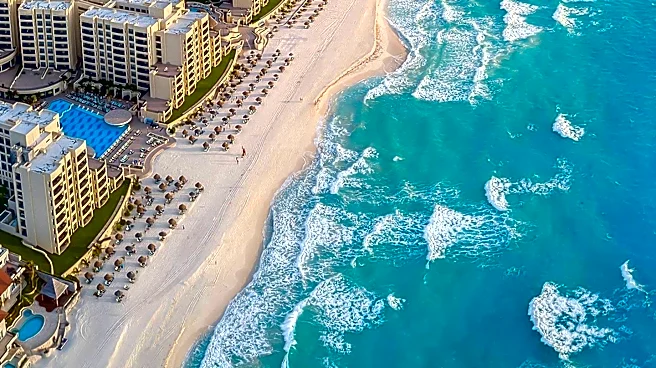
By 2022, Cancún had evolved into a large city, with the majority of its urban area now situated on the mainland. The former island of Cancún, often referred to as the "hotel zone," is primarily dedicated to large hotels, shopping centers, and entertainment venues, catering to the millions of tourists who visit annually. In 2023, Cancún welcomed a record 21 million tourists, surpassing the initial estimate of 20.5 million, highlighting its continued appeal as a global destination.
The city's population, known as 'Cancunenses,' is diverse, with residents hailing from Yucatán and other Mexican states, as well as a growing number from the Americas and Europe. This influx of people has presented challenges for municipal authorities in providing public services and managing urban development, particularly concerning irregular settlements. Despite these challenges, Cancún remains the most populous city in Quintana Roo and the seat of the municipality of Benito Juárez, a vibrant testament to its planned development and ongoing evolution.