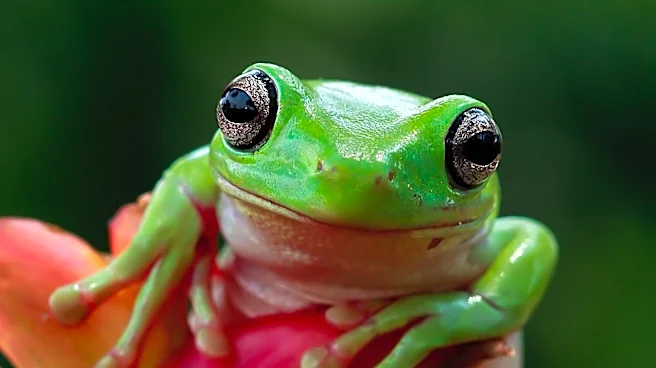







The Australian green tree frog, also known as White's tree frog or the dumpy tree frog, is a fascinating amphibian native to Australia and New Guinea. This species, scientifically named *Pelodryas caerulea*, exhibits a range of unique biological features and behaviors that allow it to thrive in its diverse habitats. From its distinctive physical appearance to its specialized methods for hydration and hunting, the green tree frog offers a compelling
study in amphibian adaptation.
Physical Characteristics and Coloration
This plump, rather large tree frog can grow up to 4.5 inches (11.5 cm) in length, with females typically being slightly larger than males. A notable feature is a fatty ridge located over its eye, alongside a moderately sized parotoid gland. The frog's eyes are golden with horizontally slit pupils, and a visible tympanum, similar to an eardrum, is situated just behind the eye. Interestingly, selective breeding has even produced individuals with blue irises.
The green tree frog's dorsal color is highly variable, influenced by temperature and its environment. It can range from brown, brownish- or grayish-green, to a vibrant emerald green. Captive breeding has also led to "honey"-toned individuals displaying colors from mauve to pale yellow. Occasionally, small, irregularly shaped white spots may appear on its back, and selective breeding has increased the prevalence of these spots in some populations. Males possess a wrinkled vocal sac under their throat, which can be gray to yellow, while females have a taut, white throat. The ventral surface in both sexes is a creamy-white and has a rough texture.
Adaptations for Survival and Hydration
The green tree frog's physical structure is well-suited for its arboreal lifestyle. Its forelimbs are short and robust, while its hind limbs are very long, ending in large, circular adhesive discs on each digit that provide excellent grip for climbing. The fingers are about one-third webbed, and the toes are nearly three-quarters webbed. These features are crucial for navigating its environment, which often includes tree canopies near water bodies.
One of the most remarkable adaptations of *P. caerulea* is its ability to manage hydration. Its skin exudes a waxy coating that helps prevent water evaporation. During dry periods, the frog avoids desiccation by finding cool, concealed spots, sometimes burrowing, and enveloping itself in a cocoon made of shed skin and mucus. This species also benefits from two hygroscopically-enabled hydration processes: transcutaneous uptake of condensation on its skin and reduced evaporative water loss. Its wiping behavior spreads hygroscopic secretions from the parotoid gland across its skin, facilitating both methods. The frog's skin structure, hygroscopic coating, and an advantageous temperature gradient work together to boost condensation and moisture uptake.
Ecology, Behavior, and Diet
Australian green tree frogs are known for being docile and unafraid of humans. They are nocturnal, emerging in the early evenings to call, especially in spring and summer, and to hunt for food. During the day, they seek out cool, dark, and moist areas like tree holes or rock crevices for sleep. While not strictly a rainforest species, they utilize the almost daily rain that collects on leaves and in crevices to stay moist. They have also been observed gathering in "clumps" while sleeping, possibly to conserve moisture through skin-to-skin contact, though evidence for them being a social species is insufficient.
The diet of the green tree frog primarily consists of insects such as moths, cockroaches, and locusts. They also consume spiders and can even prey on smaller frogs and small mammals, including various types of bats. Since frog teeth are not designed for cutting, prey must be small enough to fit into their mouths. For smaller prey, they use their sticky tongues. For larger items, they pounce and then use their hands to push the prey into their mouths. The species has an average life expectancy of 16 years in captivity, with some individuals living over 20 years. Native predators include snakes and birds, while non-native predators like dogs and cats have been introduced since European settlement in Australia.