




Backstitch is a fundamental technique in both hand sewing and embroidery, recognized for its strength and versatility. This stitch involves making individual stitches backward to the general direction of sewing, creating a robust and continuous line. In embroidery, it is primarily used for outlining shapes, adding fine details, and forming lettering. For hand sewing, backstitch serves as a utility stitch, capable of strongly and permanently joining
two pieces of fabric. Its small, interlocking stitches make it the strongest among basic hand stitches, allowing for the creation of durable seams without the need for a sewing machine.
The Technique of Backstitch
Working a basic backstitch is a straightforward process, making it accessible for various projects. It is particularly well-suited for following both simple and intricate outlines, and it can also serve as a foundational row for more complex embroidery stitches, such as the herringbone ladder filling stitch. While it might appear similar to the Holbein stitch, often seen in blackwork embroidery, backstitch distinguishes itself by requiring only a single pass to complete a line of stitching, making it efficient.For optimal results, backstitch is most easily executed on even-weave fabric. This type of fabric allows for easy counting of threads, which helps ensure the regularity and neatness of each stitch. The general practice is to work the stitch from right to left. The motion can be described as a "two steps forward, one step back" method, where the needle advances along the line to be filled, then returns to secure the previous stitch. When performed neatly and in a straight line, the resulting stitch pattern can closely resemble the chain stitching produced by a sewing machine, highlighting its clean and consistent appearance.
Applications in Embroidery
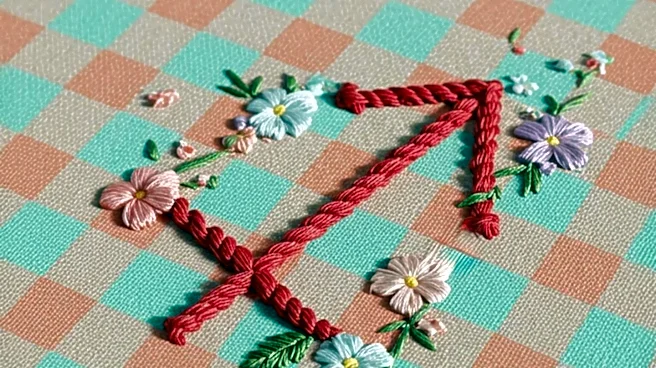
In the realm of embroidery, backstitch is a cornerstone for defining visual elements. It is the primary stitch used for outlining shapes in modern cross-stitch, providing clear boundaries for designs. It also finds application in Assisi embroidery and occasionally in blackwork, where precise lines are crucial. Beyond simple outlines, backstitch is invaluable for adding fine details to an embroidered picture, allowing artists to create intricate textures and subtle nuances. Its ability to form crisp lines also makes it an excellent choice for embroidering lettering, ensuring legibility and a polished finish.Historical Roots and Notable Variants
The family of backstitches includes several historically significant variants. The stem stitch, for instance, is an ancient technique with a rich history. Surviving mantles from the Paracas people of Peru, dating back to the first century BCE, feature embroidery done with stem stitch. This stitch also appears in the Bayeux Tapestry, an embroidered cloth from the late 1070s, where it was used for lettering and to outline areas filled with couching or laid-work. Stem stitch is characterized by each stitch overlapping the previous one to one side, forming a twisted line, with the thread passing below the needle. It is commonly employed for outlining shapes and stitching flower stems and tendrils.Another notable variant is the split stitch, which is particularly characteristic of Opus Anglicanum, a distinctive embroidery style from Medieval England, often executed in silk. Unlike basic backstitch where the needle returns to one side, in split stitch, the needle pierces the thread itself. Other variations include the outline stitch, sometimes differentiated from stem stitch by the thread passing above the needle, and the Pekinese stitch, which is a looped interlaced backstitch. These variations demonstrate the adaptability and enduring utility of the backstitch family across different embroidery traditions and historical periods.