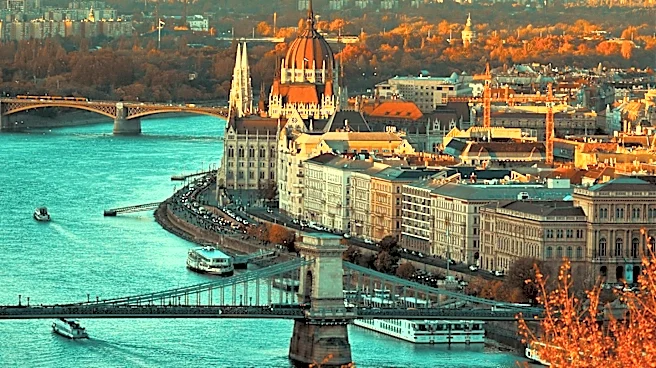









Budapest, the capital and largest city of Hungary, stands as a testament to historical unification and its deep connection to the Danube River. Formally created on November 17, 1873, this vibrant metropolis emerged from the merger of three distinct entities: Buda, Óbuda, and Pest. This strategic consolidation on both banks of the Danube River laid the groundwork for its rise as Hungary's principal political, cultural, commercial, industrial, and transportation
center. The city's unique geography, bisected by the Danube, has profoundly shaped its development and identity, earning it evocative nicknames such as "Queen of the Danube" and "Heart of Europe."
The Genesis of a Capital: From Separate Settlements to Unified Power
The origins of Budapest can be traced back to Celtic settlements in the 4th century BC, followed by Roman occupation which established Aquincum around AD 100. However, the direct precursors to modern Budapest were the towns of Buda, Óbuda, and Pest. Buda and Pest, in particular, began to develop economically in the 12th century, largely due to the influx of French, Walloon, and German settlers who engaged in trade and labor under royal protection along the Danube's banks. These towns, though devastated by the Mongol invasion in 1241–42, were subsequently rebuilt, with German colonists renaming Buda "Ofen" after its numerous lime kilns. The name Pest, of Slavic origin, also means "furnace," highlighting an early industrial character.
During the 14th century, the Angevin kings of Hungary established Buda as the royal seat, constructing palaces on Castle Hill. This period reached its zenith under King Matthias Corvinus (1458–1490), who, with his Italian-born wife Queen Beatrice of Naples, presided over a golden age of prosperity and arts patronage. Despite periods of decline, such as the 18th century when it was an insignificant provincial town under Austrian rule, the groundwork for future growth was continually being laid.
The Austro-Hungarian Compromise and Rapid Urbanization
The Austro-Hungarian Compromise of 1867 marked a pivotal moment, establishing the dual monarchy and elevating Budapest to the status of co-capital. This era spurred rapid growth and expansion, culminating in the formal merger of Buda, Óbuda, and Pest in 1873. To manage this burgeoning metropolis, the Metropolitan Board of Public Works was established in 1870, tasked with setting stringent construction standards and developing a long-term urban plan. This board, composed of aristocrats like Gyula Andrássy and Baron Frigyes Podmaniczky, meticulously planned and proportioned the inner areas of Budapest, creating large ring roads and boulevards.
Pest, in particular, underwent extensive rebuilding, drawing inspiration from Paris. Key infrastructure projects included the Nagykörút (Great Boulevard) and Andrássy Avenue, which leads to Heroes' Square and a grand park. The city's millennial anniversary celebrations in 1896, commemorating the settlement of the Magyars, further fueled a construction boom. This period saw the opening of the first line of the Budapest Metro under Andrássy Avenue, and the creation of monumental structures like Heroes' Square and Vajdahunyad Castle. New suburbs were developed to accommodate the rapidly growing and financially expanding population, which was predominantly Magyar but also included significant German and Jewish communities due to immigration. This conscious urban development, coupled with its favorable transport-geographical position reinforced by a radial road and rail network, solidified Budapest's position as a major European center by the end of the 19th century.