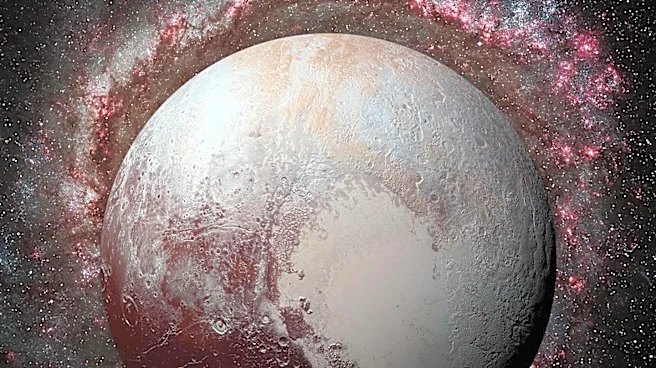









Eris, a dwarf planet discovered in 2005, has become a subject of great interest in the astronomical community. Its discovery not only challenged the status of Pluto but also expanded our understanding of the solar system's outer regions. This article explores the characteristics of Eris, its moon Dysnomia, and its significance in the broader context of the solar system.
Understanding Eris
Eris is classified as a trans-Neptunian object (TNO), specifically a scattered
disk object. These objects are known for their distant and eccentric orbits, which take them far beyond the orbit of Neptune. Eris's orbit is particularly notable for its high eccentricity, meaning it follows an elongated path around the Sun. This characteristic places Eris among the most intriguing objects in the solar system.
With a diameter of approximately 2,326 kilometers, Eris is slightly larger than Pluto, making it the most massive known dwarf planet. Its mass is about 0.28% that of Earth, and it is 27% more massive than Pluto. Despite its size, Eris has not been visited by any spacecraft, making it the largest known object in the solar system that remains unexplored by human technology.
The Moon Dysnomia
Eris is accompanied by a moon named Dysnomia, which was discovered shortly after Eris itself. The presence of Dysnomia provides valuable insights into the mass and gravitational influence of Eris. By studying the moon's orbit, astronomers can infer details about Eris's mass and density, contributing to a better understanding of its physical characteristics.
Dysnomia's discovery also highlights the potential for other moons or celestial bodies to exist around distant objects in the solar system. The study of such moons can offer clues about the formation and evolution of their parent bodies, as well as the dynamics of the outer solar system.
Significance in the Solar System
The discovery of Eris had a profound impact on the classification of celestial bodies within the solar system. It prompted the International Astronomical Union (IAU) to redefine the criteria for what constitutes a planet, leading to the creation of the dwarf planet category. This reclassification was a pivotal moment in astronomy, as it reshaped our understanding of the solar system's structure.
Eris's discovery also underscored the importance of exploring the outer solar system. It highlighted the potential for finding other significant celestial bodies that could further alter our understanding of the cosmos. As such, Eris remains a focal point for astronomers studying the outer reaches of our solar system, offering a glimpse into the complexities and wonders that lie beyond the known planets.