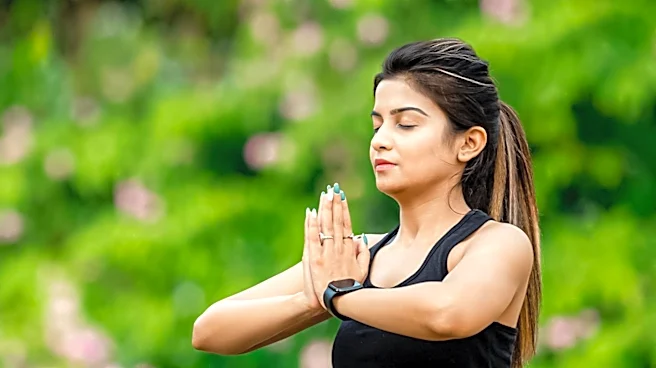


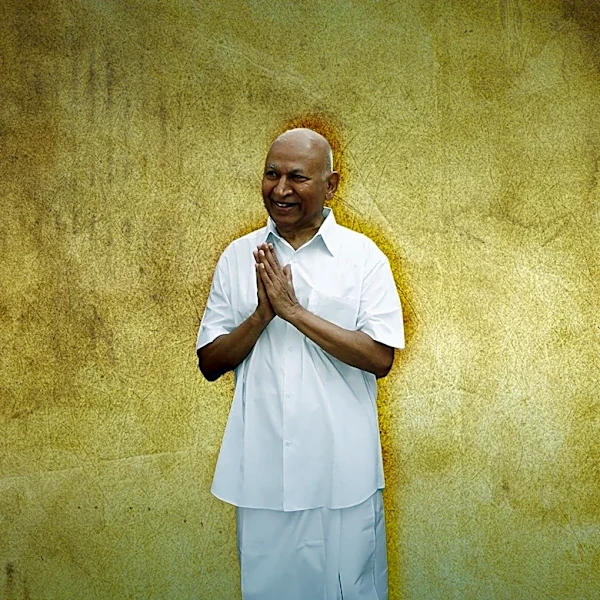

Anjali Mudra is a hand gesture primarily associated with Indian religions and arts, found across Asia and beyond. It is the specific gesture used when performing Namaste, where hands are pressed together, palms touching, fingers pointing upwards, and thumbs close to the chest. This mudra is an integral part of classical Indian dance forms like Bharatanatyam, various yoga practices, and serves as a non-verbal, visual form of communication in performance
arts. It is recognized as one of the 24 samyukta mudras in classical Indian arts, with several forms, including brahmanjali.
This gesture is widely incorporated into many yoga asanas. For example, the standing posture in modern yoga known as pranamasana involves standing upright with hands in Anjali Mudra. The mudra is also frequently depicted in Indian temple reliefs and sculptures, appearing in mandapas, at entrances, and in iconography such as the Lingobhavamurti in Shaivism. Its presence in ancient and medieval era sculpture and mandapa relief artwork in Hindu temples further highlights its historical and cultural significance.
While often used interchangeably with Namaste, Anjali Mudra has a subtle distinction. Anjali Mudra refers specifically to the non-verbal hand gesture, whereas Namaste can be spoken with or without any accompanying gesture. According to Bhaumik and Govil, there is a delicate difference between Anjali Mudra and Namaskara Mudra. In Anjali Mudra, the back of the thumbs faces the chest and can be perpendicular to the other fingers, while in Namaskara Mudra, the thumbs are aligned with the other fingers.
Sanskrit texts provide detailed descriptions of Anjali Mudra. The Natya Shastra, a classical Indian dance text dating from 200 BCE to 200 CE, describes it as a posture where hands are joined together in a respectful state. This text specifies its use for prayer before a deity, for receiving any person who is honored, and for greeting friends. The Natya Shastra further instructs that for temple prayers, Anjali Mudra should be placed near or above the head. When meeting an honorable person, it should be positioned before the face or chin, and for friends, it should be held near the chest.
Beyond its use in religious and artistic contexts, Anjali Mudra functions as a widespread sign of respect or a silent greeting in many countries, including India, Sri Lanka, Nepal, Bhutan, Burma, Thailand, Laos, Cambodia, and Indonesia. It is also adopted by East Asian Buddhists, Chinese religionists, Shintoists, and followers of similar traditions across Asia. The gesture is commonly used as part of prayer or worship in numerous Indian and other Eastern religions, underscoring its universal appeal as a symbol of reverence.
Historically, archaeological excavations at Indus Valley Civilization sites have revealed male and female terracotta figures in a posture resembling Anjali Mudra. These findings, dated to the Mature Harappan period, suggest that this gesture has been a part of cultural expression for millennia. This deep historical lineage reinforces Anjali Mudra's enduring role as a powerful and meaningful symbol of respect and spiritual connection across diverse cultures and eras.