







The 2000 Summer Olympics in Sydney, Australia, concluded with a memorable closing ceremony held on October 1, 2000, at Stadium Australia. This event, like its opening counterpart, was meticulously directed, aiming to provide a fitting end to what many considered a highly successful Games. The ceremony was not just a formal conclusion but also a celebration, incorporating elements of Australian culture and Olympic tradition, leaving a lasting impression
on attendees and viewers worldwide.
Setting the Stage: The Geodome and Pre-Ceremony Entertainment
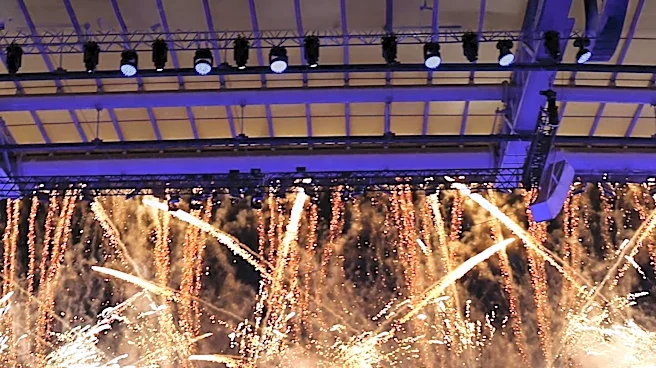
For the closing ceremony, Stadium Australia presented its track and field ground as is, with the central focus being the "Geodome Stage." This innovative stage design was positioned in the middle of the stadium, serving as the primary performance area. Before the official proceedings began, a prelude segment was hosted by Roy and HG, setting a lighthearted tone for the evening. A recording of the countdown, originally composed by Richard Mills and performed by the Sydney Symphony Orchestra for the opening ceremony, was played again, with large screens counting down from 60 to 1. As the countdown reached 23, footage from previous Olympic Games appeared, building anticipation. The final moment of the countdown, at 0, showcased fireworks footage followed by an image of a Ken Done drawing emblazoned with the phrase "Let's Party!"
Adding a touch of humor, a slapstick skit was performed just before the countdown. This comedic interlude depicted a groundskeeper losing control of his buggy, causing a humorous disruption to the pomp and ceremony. In one scene, the character Birch appeared on a bike, accompanied by an inflatable kangaroo, a nod to the handover segment of the 1996 closing ceremony. The mascots of the Games also made their only appearance during this skit, interacting with the runaway buggy. The segment concluded with the vehicle being comically dismantled, providing a lighthearted start to the formal events.
Cultural Performances and Athlete Traditions
Following a brief fanfare composed by David Stanhope, the protocol section of the ceremony commenced with a powerful cultural performance. Christine Anu, accompanied by Torres Strait Island dancers, performed her rendition of the Warumpi Band's song "My Island Home," written by Neil Murray. Anu performed on the Geodome Stage, while several Aboriginal dancers graced the top of the stage. Around them, hundreds of children holding umbrellas and lampboxes created intricate images representing Aboriginal Dreamtime. The version of the song performed was the recently released Earth Beat mix, which featured altered lyrics to evoke the idea that the "island" being sung about was Australia itself. Towards the end of her performance, Anu was hoisted on a part of the stage that folded into a giant 8-sided octagonal figure called The Geode, onto which a globe was projected. Audience members were encouraged to wave their flashlights, creating a unified visual spectacle.
A cherished Olympic tradition, initiated at the 1956 Melbourne Olympics by a young man named John Ian Wing, was once again observed: the entrance of the athletes. Instead of marching as separate national teams behind their flags, athletes from all participating countries mingled together as they paraded into and around the arena. This tradition, which has been followed ever since, symbolizes unity and sportsmanship. The flags of all countries entered with their flag bearers before being placed on the Geode stage. As the flags were positioned, athletes streamed in from all entrances onto the field, accompanied by David Stanhope's fanfare "Olympic Fireworks" and Chong Lim's orchestral piece "Journey of Angels." Savage Garden performed their hit song "Affirmation" on the Geode stage, wearing indigenous flag t-shirts. The Geode stage projected various words related to personal affirmations, including Sydney's famous graffiti, "Eternity," further connecting the ceremony to the host city's unique identity.
The End of an Era and a Benchmark for Future Games
The 2000 Summer Olympics were the final Games under the IOC presidency of Juan Antonio Samaranch before his successor, Jacques Rogge, took over. The closing ceremony marked the official end of this era. The Games themselves received universal acclaim, with the organization, volunteers, sportsmanship, and the Australian public being widely praised in the international media. Bill Bryson of The Times called the Sydney Games "one of the most successful events on the world stage," stating they "couldn't be better." James Mossop of the Electronic Telegraph noted that the Games were "such a success that any city considering bidding for future Olympics must be wondering how it can reach the standards set by Sydney." Jack Todd of the Montreal Gazette even suggested that the "IOC should quit while it's ahead. Admit there can never be a better Olympic Games, and be done with it," proclaiming Sydney as "both exceptional and the best." These accolades highlight the high bar set by the Sydney Games, with the closing ceremony serving as a powerful final statement of their success and enduring legacy. The inspiration drawn from these Games was evident in London's winning bid for the 2012 Olympics, with Lord Coe declaring the 2000 Games the "benchmark for the spirit of the Games, unquestionably," and admitting that the London organizing committee "attempted in several ways to emulate what the Sydney Organising Committee did."