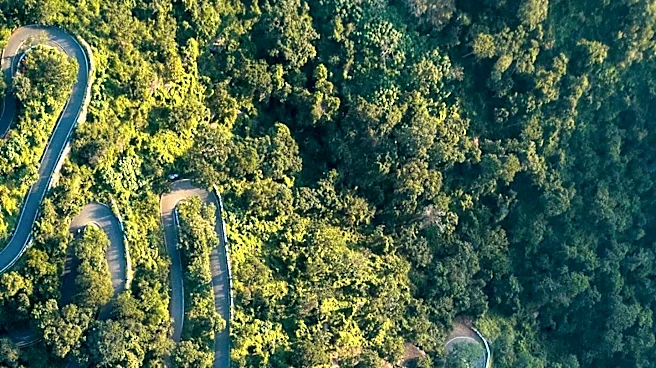






Hairpin turns, also known as hairpin bends, curves, or corners, represent a crucial engineering solution for navigating challenging topography. These distinctive road features are characterized by an extremely acute inner angle, demanding a vehicle to execute an approximate 180-degree turn to stay on course. Their name is derived from their visual resemblance to a bent metal hairpin, a common household item. Primarily, these turns are strategically
implemented to mitigate the steepness of a grade where a road must ascend or descend a significant slope, making them indispensable in mountainous regions and other areas with dramatic elevation changes.
Strategic Placement and Design Principles
The fundamental purpose of hairpin turns is to facilitate safer and more manageable travel through steep terrain. By introducing these sharp bends, engineers can effectively decrease the overall gradient of a road. Instead of a direct, steep climb or descent that would be difficult and potentially dangerous for vehicles, the road is extended horizontally through a series of turns. This design allows for a more gradual change in elevation, making ascents and descents less strenuous for vehicles and their occupants. The turns are frequently arranged in a zigzag pattern, further optimizing the use of available space on a steep hillside.
Enhancing Safety and Efficiency in Mountainous Regions
While hairpin turns undeniably increase the total travel distance and typically necessitate lower speed limits due to their sharp curvature, the benefits in terms of safety and accessibility are substantial. They provide a practical method for vehicles to traverse mountainous landscapes that would otherwise be impassable or extremely hazardous. Without these engineered curves, the only alternatives might be prohibitively steep roads or the construction of expensive and complex tunnels. The design of hairpin turns, therefore, offers a cost-effective and efficient way to open up challenging terrain for transportation.
Economic Advantages and Maintenance Considerations
Beyond their immediate functional benefits, highways incorporating hairpin turns often prove to be more economical in both construction and long-term maintenance compared to alternatives that rely heavily on tunnels. Tunnels, while offering a direct route, involve significant excavation, structural reinforcement, and ongoing operational costs. Hairpin turns, by contrast, utilize the natural contours of the land, albeit with extensive road construction, which can be less resource-intensive than tunneling through solid rock. This economic advantage makes them a preferred solution in many regions where budget constraints are a factor.
Variations and Analogous Structures
The concept of a sharp turn to manage elevation is not exclusive to roads. In American English, similar turns on ramps and trails are often referred to as switchbacks, drawing an analogy to switchback railways. When this routing geometry is applied to a rail line, it takes on the name of a spiral or a spiral loop, indicating a track that loops back on itself to gain or lose elevation. For footpaths and trails, stairways might be employed as an alternative to switchbacks, especially in very confined or extremely steep areas. Even in railway engineering, a horseshoe curve describes a track that curves back on itself like a hairpin, though typically with a much larger radius of curvature than a road hairpin, reflecting the different operational requirements of trains.