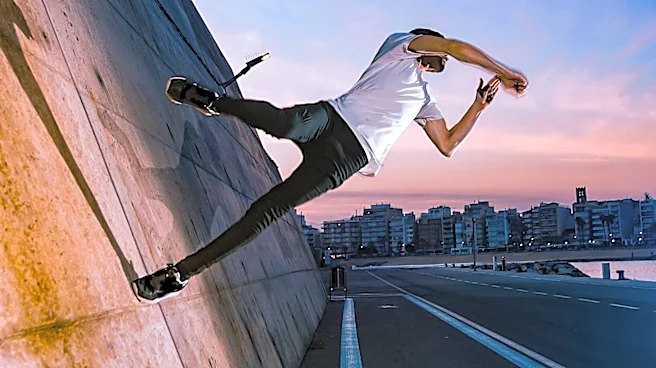





Parkour, a discipline that involves moving through environments using only the body's abilities, has a rich history that traces back to military training and has evolved into a global phenomenon. Developed in France by Raymond Belle and his son David Belle, parkour has grown from a method of efficient movement to a widely practiced art form. This article explores the origins and evolution of parkour, highlighting its journey from military roots to a modern-day
practice.
Early Beginnings
The roots of parkour can be traced back to the early 20th century with the development of the "méthode naturelle" by Georges Hébert. Hébert, a French naval officer, was inspired by the natural movements of indigenous tribes in Africa, which he observed to be both efficient and graceful. He believed that physical training should encompass a variety of movements, including running, jumping, and climbing, to develop a well-rounded individual. This philosophy laid the groundwork for what would later become parkour.
Raymond Belle, who was trained in these methods, further developed his skills during his time in the military. His experiences in the Vietnam War, where he learned escape techniques, influenced his approach to movement. Upon returning to France, Raymond passed on his knowledge to his son, David Belle, who would go on to formalize and popularize parkour.
The Rise of Parkour
In the late 1980s, David Belle began to experiment with the techniques he learned from his father, applying them to the urban environment of Lisses, a suburb of Paris. Along with a group of friends, including Sébastien Foucan, Belle formed the Yamakasi group, which focused on developing and refining parkour techniques. The group emphasized the importance of overcoming obstacles efficiently and creatively, a principle that remains central to parkour today.
As the Yamakasi group gained attention, parkour began to spread beyond France. The discipline was featured in films, documentaries, and advertisements, which helped to popularize it globally. By the 2000s, parkour had become a recognized practice, with practitioners, known as traceurs, forming communities around the world.
Modern Parkour
Today, parkour is practiced by people of all ages and backgrounds. It has evolved to include elements of freerunning, which emphasizes artistic expression and creativity in movement. While parkour remains rooted in the principles of efficiency and overcoming obstacles, freerunning allows practitioners to incorporate acrobatic and stylistic elements.
The discipline has also seen the development of competitive events, with organizations hosting parkour championships. Despite this, many practitioners emphasize that parkour is not just a sport but a way of life, focusing on personal growth and self-expression. As parkour continues to evolve, it remains a testament to the power of movement and the human spirit.