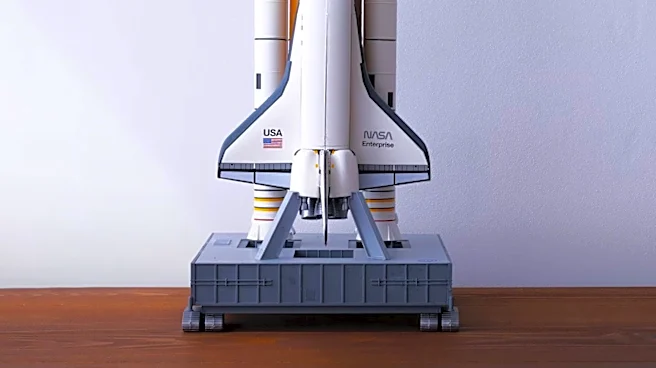







Space Shuttle Enterprise, designated OV-101, holds a unique and crucial place in the history of NASA's Space Shuttle program. Unlike its sister orbiters that ventured into space, Enterprise was specifically designed and built as a test vehicle. Its primary purpose was to undergo extensive atmospheric flight tests and ground evaluations, laying the essential groundwork for the operational space shuttles that would follow. This pioneering craft, though
never reaching orbit, was instrumental in proving the fundamental concepts and capabilities of the shuttle design, ensuring the safety and functionality of future space missions.
Conception and Construction of a Test Orbiter
Construction of the Space Shuttle Enterprise began on June 4, 1974, and it was officially completed on September 17, 1976. From its inception, Enterprise was distinct from the space-faring orbiters. It was deliberately built without engines, which were essential for propulsion into space, and it lacked the critical heat protection system necessary for re-entry into Earth's atmosphere. These omissions were not oversights but rather a reflection of its intended role as a testbed, where the focus was on aerodynamic performance and structural integrity rather than spaceflight capabilities.The decision to build Enterprise in this manner allowed NASA to conduct a wide range of tests without the added complexity and cost of full spaceflight systems. This approach enabled engineers and scientists to thoroughly evaluate the shuttle's design in a controlled environment, addressing potential issues before committing to the construction of operational orbiters. The foundational work performed on Enterprise was vital for the success of the entire Space Shuttle program, demonstrating the feasibility of a reusable spacecraft design.
Atmospheric Flight Tests and Gliding Performance
In 1977, Enterprise embarked on a series of critical flight tests. One of the initial objectives was to assess how the shuttle could be transported atop a modified Boeing 747. This involved several test flights where the Enterprise remained joined to the Boeing 747, including three manned test flights. These tests were crucial for understanding the aerodynamic interactions between the two large aircraft and for developing procedures for ferrying the orbiters.Following these initial transport tests, Enterprise underwent another five test flights where it flew independently, albeit without engines, functioning as a glider. During these unpowered flights, pilots practiced landing the shuttle at the Edwards Air Force Base. Astronauts such as Gordon Fullerton, Apollo 13 astronaut Fred Haise, Joe Engle, and Dick Truly were among those who piloted Enterprise during these vital landing practice sessions. These tests were paramount for validating the shuttle's aerodynamic characteristics and for refining the complex landing procedures that would be used by future space-faring orbiters upon their return from space.
Post-Flight Testing and Legacy
After its extensive flight test program, Enterprise continued to serve a valuable role in the Space Shuttle program. It was utilized for vibration tests conducted at NASA's Marshall Space Flight Center in Huntsville, Alabama. These tests helped engineers understand the structural dynamics of the orbiter and ensure its resilience under various conditions. The data gathered from these vibration tests contributed to the overall design and safety of the subsequent operational shuttles.Upon the completion of all its testing phases, some components from Enterprise were repurposed and used in the construction of other space shuttles. This practice highlights the practical and resource-efficient approach taken by NASA. Although Enterprise never left Earth's atmosphere, its contributions were foundational. It proved the viability of the Space Shuttle concept, trained astronauts in critical flight maneuvers, and provided invaluable data that directly informed the design and construction of the orbiters that would eventually carry humans and payloads into space. Today, Enterprise stands as a testament to the rigorous testing and development that underpinned one of humanity's most ambitious space exploration programs.