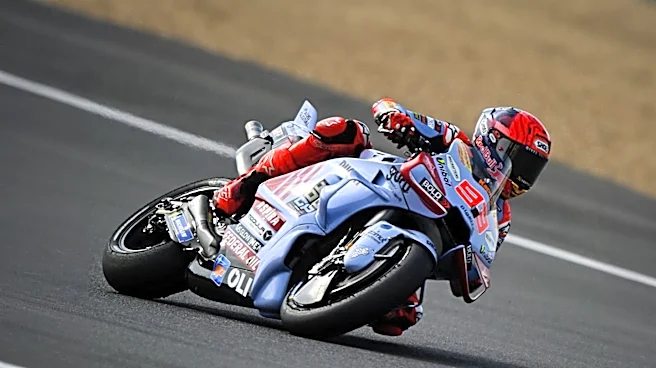




Grand Prix motorcycle racing stands as the premier championship in motorcycle road racing, a sport with a rich history dating back to 1949. Governed by the Fédération Internationale de Motocyclisme (FIM), this championship has evolved into a sophisticated series featuring multiple classes, intricate technical regulations, and a well-defined event format. The sport's structure is designed to balance competitive racing with safety, continuously adapting
to technological advancements and the demands of a global audience. Understanding its organizational framework, from its governing bodies to its scoring system, provides insight into the complexity and excitement of this high-speed discipline.
Governance and Key Entities
The FIM, established in 1949, is the sport's sanctioning body and plays a crucial role in its governance. While the FIM sets the overarching rules, the commercial rights to Grand Prix motorcycle racing are now owned by Dorna Sports. This creates a collaborative, yet sometimes complex, decision-making process involving several key entities. Teams are represented by the International Road Racing Teams Association (IRTA), and manufacturers by the Motorcycle Sport Manufacturers Association (MSMA).
Rules and changes to regulations are decided through discussions among these four entities: Dorna Sports, FIM, IRTA, and MSMA. In instances where a tie-breaking vote is needed, Dorna Sports holds that authority. For technical modifications, the MSMA possesses the unique ability to unilaterally enact or veto changes, provided there is a unanimous vote among its members. Together, these four entities form the Grand Prix Commission, which is responsible for shaping the future of the sport.
Evolution of Classes and Engine Regulations
Throughout its history, Grand Prix motorcycle racing has featured various classes based primarily on engine size. When the championship began in 1949, it included 500cc, 350cc, 250cc, 125cc, and sidecar classes. Over the decades, new classes were introduced, such as the 50cc class in 1962, and others were discontinued or rebranded. The 350cc class was dropped after 1982, and the 50cc class was replaced by an 80cc class from 1984 to 1989 before being dropped entirely for the 1990 season.
A significant shift occurred in engine technology. While four-stroke engines dominated through the 1950s and most of the 1960s, two-stroke engines began to gain prominence in the smaller classes due to design advancements. By the mid-1970s, two-strokes had completely eclipsed four-strokes across all classes. In 2002, a major rule change aimed to phase out the 500cc two-strokes. The premier class was rebranded MotoGP, allowing manufacturers to choose between 500cc two-strokes or four-strokes up to 990cc. The four-stroke engines quickly proved superior, and by 2003, no two-stroke machines remained in MotoGP.
Further class restructuring continued. In 2007, MotoGP's maximum engine displacement was reduced to 800cc. The 250cc two-stroke class was replaced by the Moto2 600cc four-stroke class in 2010, and the 125cc two-stroke class was replaced by the Moto3 250cc four-stroke class in 2012. The MotoGP engine capacity was increased back to 1,000cc for the 2012 season. More recently, the MotoE class, featuring electric motorcycles, was introduced in 2019 as a World Cup and achieved World Championship status from 2023 to 2025.
Event Format and Scoring System
A typical Grand Prix race weekend culminates in a main race on Sunday, but the event format has seen recent additions. The starting grid for the main race consists of around 20 riders, arranged in three columns. Grid positions are determined by qualifying speeds, with the fastest rider securing pole position. Each Grand Prix race is a 45-minute sprint, designed to be completed without fuel or tire stops.
In 2005, a "flag-to-flag" rule was introduced for MotoGP to address changing weather conditions. If rain begins during a dry race, a white flag is shown, allowing riders to pit and swap their motorcycles for identical ones equipped with different tires (intermediates or wets instead of slicks). These wet-weather bikes also feature steel brake rotors and different brake pads, as carbon brakes require high temperatures to function effectively and are cooled too much by water. The suspension is also softened for wet conditions. If a fallen rider cannot be safely evacuated, the race is red-flagged.
Motorcycle crashes are generally categorized as lowside, where the bike loses tire grip and slides on its side, or the more dangerous highside, where the tires regain grip, flipping the bike and often catapulting the rider. Increased use of traction control has reduced the frequency of highsides. The 2023 season introduced "sprint" races on Saturdays, which are approximately half the length of a Grand Prix and award about half the points. The current points system for Grand Prix races awards 25 points for first place down to 1 point for fifteenth place. For sprint races, 12 points are awarded for first place down to 1 point for ninth place.