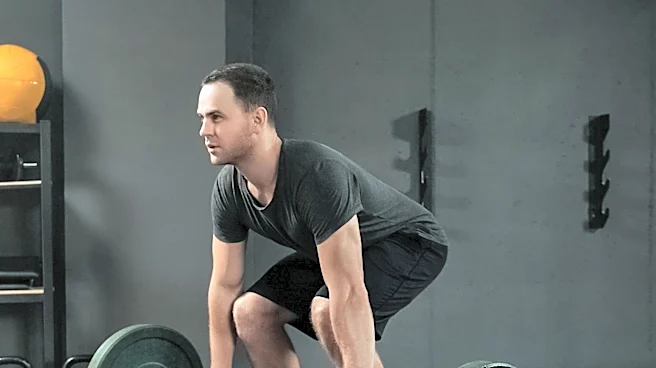





The deadlift stands as a paramount test of strength in powerlifting, demanding a full-body effort to lift a loaded barbell from the floor to a standing position. This exercise is not only a measure of raw power but also a complex movement with various techniques and equipment considerations that can significantly impact performance and safety. Understanding the nuances of the deadlift, from its different styles to the specific grips and assistive
gear, is crucial for anyone looking to master this challenging lift. The deadlift is a core component of powerlifting, alongside the squat and bench press, and its mastery is often seen as a hallmark of true strength.
Conventional vs. Sumo Deadlift and Grip Techniques
In competitive settings, two primary styles of deadlift are commonly employed: the conventional deadlift and the sumo deadlift. Both are permitted under powerlifting rules, though strongman competitions typically only allow the conventional stance. The choice between these styles often depends on a lifter's body mechanics and strengths. Beyond stance, grip is a critical factor. Three main grips are used: the overhand (pronated) grip, the mixed overhand-underhand (supinated) grip (also known as alternating, mixed, offset, or staggered), and the hook grip. The double overhand grip offers the least friction and is generally the weakest, as the bar can roll out if the fingers open. The mixed grip counteracts this by sandwiching the bar between hands pressing in opposite directions, maintaining friction even if the fingers begin to open. The hook grip, with both hands pronated, enhances friction by trapping the thumb between the bar and forefingers, providing a very secure hold.Many powerlifters will start their lower weight sets with an overhand grip and transition to a mixed grip for heavier lifts to achieve their one-repetition maximum. Strongman competitors, however, often use an overhand grip with the aid of straps, which are generally not permitted in powerlifting competitions. The distinction in grip usage highlights the different demands and rulesets between powerlifting and strongman disciplines. The ability to maintain a secure grip is paramount, especially when attempting to break records, such as the progression of the deadlift world record, which showcases incredible feats of strength.
Equipment and Assistance in Deadlifting
Powerlifting distinguishes between raw and equipped lifting, with different equipment allowed in each category. Weightlifting belts are universally permitted and assist by allowing the athlete to achieve higher intra-abdominal pressure, which helps stabilize the core during the lift. In equipped competitions, lifters may use deadlift suits or briefs. These are elastic garments designed to store energy as the lifter bends down, releasing it to assist with the upward movement. Equipped lifting further differentiates between single-ply (one layer) and multi-ply (two or more layers) equipment, with multi-ply suits offering greater assistance due to their increased elasticity and support.Strongman competitions often have different rules regarding equipment. While straps are generally forbidden in powerlifting, most strongman events allow them. Standard figure-6 straps are common, and some competitions even permit figure-8 straps. The latter allows the lifter to hold the bar with their fingertips, potentially reducing the distance the bar travels by over an inch, which can be a significant advantage. Additionally, chains and resistance bands can be attached to the barbell to create a 'variable resistance deadlift,' altering the resistance at different phases of the lift to target specific weaknesses or enhance strength gains throughout the range of motion.
Specialized Deadlift Variations for Targeted Training
Beyond the standard conventional and sumo deadlifts, numerous variations exist to address specific weaknesses or to train particular muscle groups. For instance, if a lifter struggles with breaking contact at maximum weight, deficit deadlifts are performed by standing on a platform, increasing the range of motion and strengthening the gluteus maximus and hamstrings. Conversely, if the lifter has difficulty locking out the weight at the top, rack pulls are used. These involve lifting the bar from an elevated position, strengthening the upper back, posterior deltoids, and trapezius, which are crucial for the lockout phase.Other variations include the Romanian deadlift (RDL), which focuses on hinging at the hips with a slight knee bend to emphasize hamstrings and glutes, and the stiff-leg deadlift (SLDL), which minimizes knee bend to intensify demand on the lower back and hamstrings. The trap bar/hex bar deadlift, performed with a hexagonal bar, allows for a neutral grip and can be less taxing on the lower back, potentially enabling greater power generation. Partial deadlifts or elevated deadlifts reduce the range of motion to focus on stronger phases of the lift, while single-leg deadlifts enhance balance and core stability. These specialized variations allow lifters to meticulously refine their technique and build comprehensive strength, contributing to the progression of the squat world record and other powerlifting achievements.