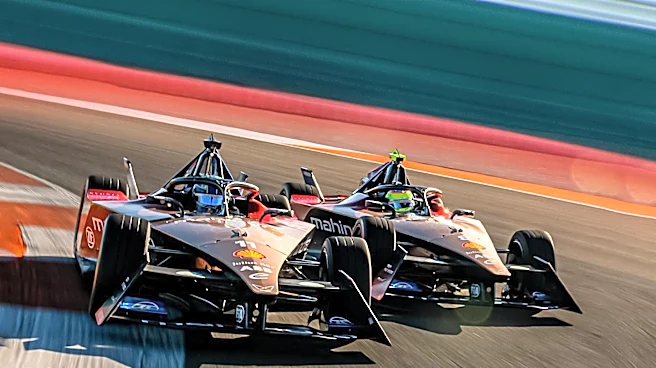



The ABB FIA Formula E World Championship, an international single-seater electric motorsport series, has seen a rich history of competition since its inaugural season in 2014–15. Over the years, various drivers and teams have etched their names into the record books, showcasing the evolving landscape of electric racing and the intense competition within the series. The championship awards two annual titles: one for the drivers and another for the teams,
determined by a points system across a series of races known as ePrix.
Points are awarded to the top ten drivers using the standard FIA system (25–18–15–12–10–8–6–4–2–1). Additionally, the driver securing pole position receives 3 points, and the driver setting the fastest lap (if they finish in the top ten) earns 1 point. For Seasons 6 and 7, the driver achieving the fastest lap during group qualifying was also awarded 1 point. A driver's end-of-season total is based on their best results, while a team's total is calculated by combining both drivers' scores throughout the season. This comprehensive scoring system ensures that consistency and performance are rewarded across the championship.
Early Dominance and Emerging Contenders
The second season of Formula E, spanning from October 2015 to July 2016, saw Sébastien Buemi clinch the drivers' championship by a mere two points over Lucas di Grassi, largely due to claiming the fastest lap in the final race in London. The following season, 2016–17, Lucas di Grassi reversed his fortunes, winning the championship in the last race, 24 points ahead of Buemi. The Renault e.Dams team successfully defended their team championship title during this period, demonstrating early dominance in the constructors' battle. The 2017–18 season saw Jean-Éric Vergne secure the drivers' title with a race to spare in New York. In a dramatic turn, Audi Sport ABT Schaeffler improved significantly in the second half of the season to overtake Techeetah in the final race, claiming the teams' championship by just two points.
World Championship Status and Recent Victories
With the 2020–21 season, the championship officially became an FIA World Championship, joining prestigious series like Formula One and the World Endurance Championship. This season saw Nyck de Vries secure his first Drivers' Championship at the Berlin ePrix, driving for Mercedes-EQ. Mercedes also celebrated their first Teams' Championship, marking a significant milestone for the manufacturer in electric motorsport. The 2021–22 season, the final season of the "Gen2" car era, saw Stoffel Vandoorne win the Drivers' title, while Mercedes EQ secured their second consecutive teams' championship. The most recent season, 2022–23, which debuted the Gen3 era, crowned Jake Dennis (Avalanche Andretti Formula E) as the drivers' champion, with Envision Racing taking home the teams' championship. These champions reflect the intense competition and the continuous evolution of talent and technology within Formula E.