
The Williamsburg Bray School, established in 1760 in Williamsburg, Virginia, stands as a significant historical landmark in the education of Black children in the United States. Founded at the suggestion of Benjamin Franklin, this institution provided schooling for both free and enslaved Black children during a period when formal education for this demographic was largely opposed in society. Operating for fourteen years until its closure in 1774,
the school educated potentially hundreds of students, leaving a notable, though often overlooked, legacy in early American history. Its building is recognized as the "oldest extant building in the United States dedicated to the education of Black children," underscoring its unique place in the nation's past.
Founding and Early Leadership
The school, known by various names including the Bray School, "Negroe School," or the "Charity School," officially opened on Michaelmas, September 29, 1760. Benjamin Franklin played a crucial role in its inception, selecting two key individuals to oversee its operations. These were Thomas Dawson, the rector of Bruton Parish and president of the College of William & Mary, and William Hunter, the publisher of The Virginia Gazette. Dawson's involvement was particularly important, as his position afforded the school a degree of security in a society generally resistant to the education of Black individuals. He had long been an advocate for Black religious education, demonstrating a commitment to the school's mission.
However, the school faced early challenges with the loss of its initial leadership. Thomas Dawson passed away just two months after the school opened, and William Hunter followed him in death the following August. Despite these setbacks, the Associates of Dr. Bray, the organization behind the school, appointed further local trustees to ensure its continued operation. Robert Carter Nicholas emerged as the longest-serving among these trustees, providing stability and guidance during the school's active years. This early period highlights the dedication required to establish and maintain such an institution against prevailing societal norms.
Educational Mission and Societal Context
The primary mission of the Williamsburg Bray School was to provide education to Black children, both those who were free and those who were enslaved. This initiative was groundbreaking, given the widespread opposition to Black education in 18th-century Virginia. The school's existence, supported by figures like Benjamin Franklin and local leaders, suggests a complex and sometimes contradictory social landscape regarding race and education during the colonial era. While the broader society often denied educational opportunities to Black individuals, the Bray School offered a rare avenue for learning, focusing on religious instruction and basic literacy.
The school's operation from 1760 to 1774 means it functioned during a critical period leading up to the American Revolution. Its closure in 1774 marks the end of a fourteen-year effort to provide formal schooling to Black children in Williamsburg. The impact of this education on the hundreds of students who attended is difficult to fully quantify, but it undoubtedly offered them skills and knowledge that were otherwise largely inaccessible. The very existence of the school challenges simplistic narratives of colonial education, revealing pockets of effort dedicated to the intellectual development of Black communities.
Preservation and Modern Significance
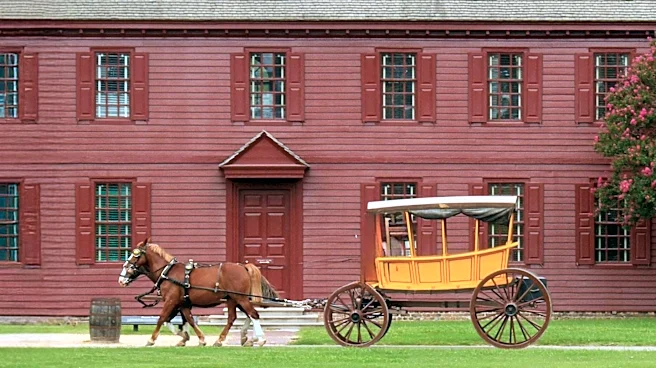
The physical building that housed the Williamsburg Bray School has a remarkable story of survival. Many structures from the 1920s restoration efforts in Williamsburg were demolished, making the preservation of this particular building exceptional. Described as the United States' "oldest schoolhouse for Black children," its continued existence offers a tangible link to this important chapter of American history. In a significant event on February 10, 2023, the building was moved a half-mile from the College of William & Mary campus into Colonial Williamsburg, where it is undergoing restoration.
The new location for the school building is particularly symbolic, situated alongside the recently discovered brick foundations of the original First Baptist Church. This church was among the first Black churches in the country, creating a powerful historical juxtaposition. The restoration and relocation efforts aim to open the school building to public exhibition following the completion of the work, with a ribbon-cutting ceremony commemorating its opening held on Juneteenth, 2025. This modern-day attention ensures that the legacy of the Williamsburg Bray School and its pioneering role in Black education will be recognized and understood by future generations.