
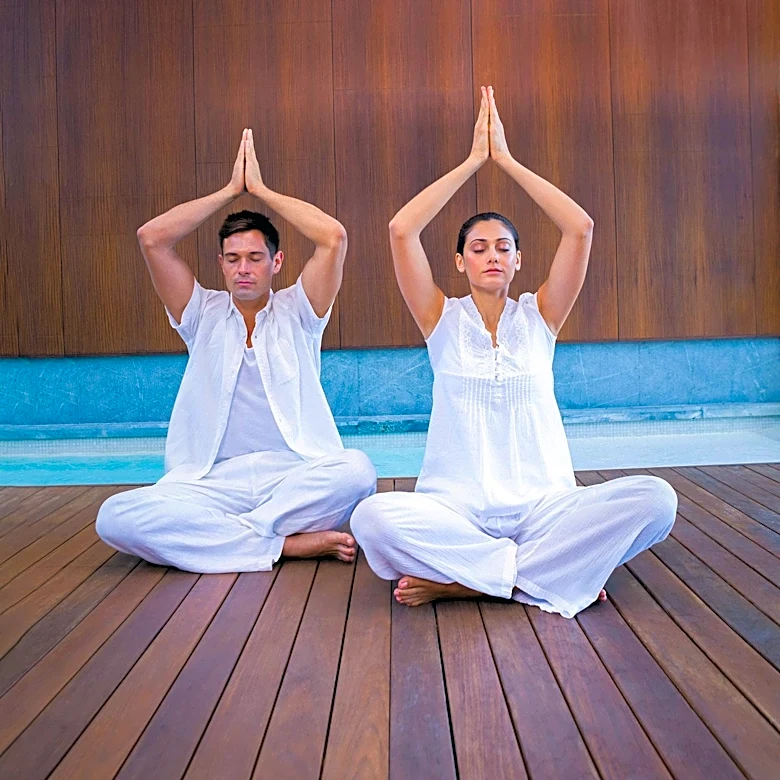



Siddhasana, also known as Accomplished Pose, is a foundational seated meditation posture within hatha yoga and modern yoga as exercise. Its history stretches back centuries, making it one of the oldest known asanas. This pose is not merely a physical arrangement but holds deep spiritual significance, often described as a gateway to liberation and a means to purify the subtle body. Its enduring presence in ancient texts highlights its importance in the pursuit
of meditative states and spiritual development.
The name Siddhasana itself offers insight into its purpose. It comes from the Sanskrit words "siddha," meaning both "perfect" and "adept," and "asana," meaning "posture" or "seat." This etymology suggests that the pose is considered perfect or that it is the seat of an adept practitioner. Ann Swanson notes that the pose is called accomplished because it was seen as the ultimate goal of all other asanas, preparing the body to sit in meditation in this specific way. This underscores its role as a culmination of physical preparation for deeper spiritual practices.
Historical Roots in Hatha Yoga Texts
Siddhasana's ancient origins are well-documented in early hatha yoga texts. It is described as a meditation seat in the 10th-century Goraksha Sataka, one of the earliest known hatha yoga texts. This text emphasizes Siddhasana's significance, stating that it ranks alongside Padmasana, or lotus position, as the most important of the asanas. The Goraksha Sataka further asserts that Siddhasana opens the way to liberation, highlighting its profound spiritual implications even in its early descriptions.
Further praise for Siddhasana appears in the 15th-century Hatha Yoga Pradipika. This influential text suggests that once Siddhasana has been mastered, all other asanas become unnecessary. It poses the question, "When Siddhasana is mastered, of what use are the various other postures?" This implies that the pose is so complete and effective in its purpose that it negates the need for other physical practices, solidifying its status as a supreme posture within the hatha yoga tradition.
The "Chief of All Asanas" and Subtle Body Purification
The Hatha Yoga Pradipika describes Siddhasana as "the opener of the door of salvation" and "the chief of all asanas." This elevated status is attributed to its ability to cleanse the impurities of 72,000 nadis. Nadis are channels of the subtle body, and their purification is considered crucial for spiritual progress in yogic philosophy. The idea that a single posture can have such a profound effect on the subtle energy system underscores the deep spiritual and energetic understanding embedded in these ancient practices.
The concept of nadis and their purification is central to the yogic understanding of the body beyond its physical form. By cleansing these channels, Siddhasana is believed to facilitate the flow of vital energy, or prana, leading to enhanced well-being and spiritual awakening. This makes Siddhasana not just a physical exercise but a powerful tool for inner transformation, aligning the practitioner with higher states of consciousness and ultimately, liberation. The emphasis on the subtle body highlights the holistic nature of hatha yoga, where physical postures serve as a means to influence deeper energetic and spiritual dimensions.
Variations and Related Poses
While Siddhasana is a distinct pose, some variations and related postures exist. The names Muktasana, or Liberated Pose, and Burmese position are sometimes used interchangeably with Siddhasana, or they may refer to an easier variant known as Ardha Siddhasana. Another related pose, Svastikasana, involves tucking each foot as snugly as possible into the fold of the opposite knee. These variations suggest a spectrum of seated meditation postures, with Siddhasana often considered the most potent or accomplished.
The existence of these related poses indicates a tradition of adapting and refining meditation seats to suit different practitioners or purposes. However, the consistent emphasis on Siddhasana across various texts points to its unique and revered position. The detailed descriptions of its physical setup, including the precise placement of heels and ankles, further illustrate the meticulous attention given to this posture to maximize its spiritual benefits and ensure a stable and comfortable seat for extended meditation.