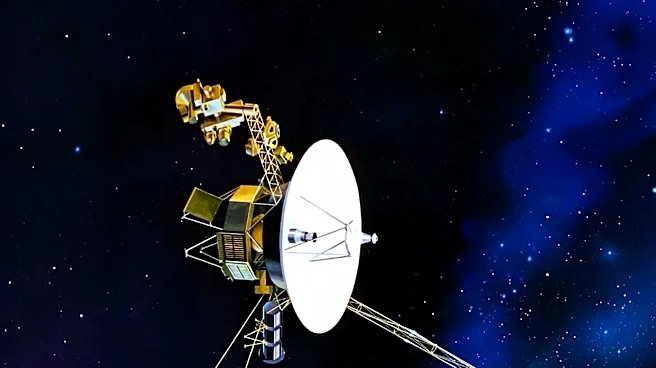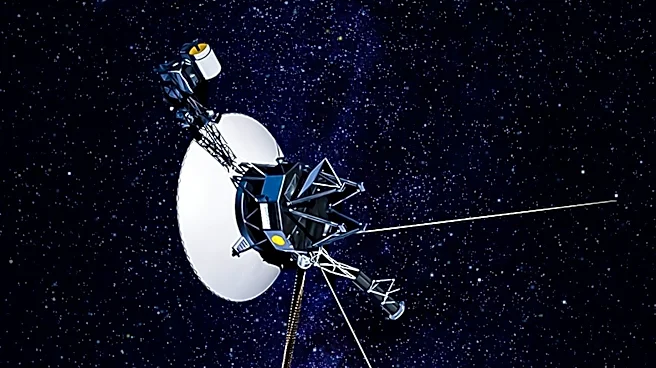

Launched in 1977, Voyager 2 has transcended its initial mission of exploring the outer planets to embark on an even more profound journey: the study of interstellar space. After successfully visiting Jupiter,
Saturn, Uranus, and Neptune, the spacecraft entered its extended mission, focusing on the vast, uncharted territory beyond the Sun's heliosphere. This remarkable probe, along with its twin Voyager 1, is providing humanity with its first direct measurements of the interstellar medium, offering invaluable insights into the environment between stars. As of February 2026, Voyager 2 is an astonishing 143.05 AU (21.4 billion km; 13.3 billion mi) from Earth, continuing its solitary voyage into the cosmic unknown.
Crossing the Boundary: Entering Interstellar Space
Voyager 2 officially entered the interstellar medium on November 5, 2018. At this point, it was approximately 119.7 AU (11.1 billion mi; 17.9 billion km) from the Sun, traveling at a speed of 15.341 km/s (34,320 mph) relative to our star. This milestone made Voyager 2 the second human-made object, after Voyager 1, to cross the heliopause – the outer boundary of the heliosphere, which is the protective bubble of plasma blown by the Sun. Before reaching the heliopause, Voyager 2 had crossed the termination shock, the inner boundary of the heliosheath, at 84 AU in August 2007. The heliosheath itself is a turbulent region that lies between the termination shock and the heliopause.
This transition into interstellar space is not merely a geographical marker; it represents a new phase of scientific discovery. Voyager 2 has begun to provide the first direct measurements of the density and temperature of the interstellar plasma, offering crucial data that cannot be obtained from within the heliosphere. These measurements are vital for understanding the properties of the space between star systems and how our solar system interacts with its galactic environment.
Powering the Distant Journey: RTGs and Power Management
To sustain its decades-long mission, Voyager 2 is equipped with three multihundred-watt radioisotope thermoelectric generators (MHW RTGs). Each RTG contains 24 pressed plutonium oxide spheres, and at launch, they collectively supplied the spacecraft with 470 watts of electrical power. The power output of these RTGs halves approximately every 87.7 years. Initially, they were predicted to allow operations to continue until at least 2020. However, through careful power management and innovative engineering, the mission has extended its operational lifespan.
In October 2024, NASA announced the plasma science instrument had been turned off to preserve power for the remaining four instruments. Further power conservation measures were planned, with NASA announcing in March 2025 its intention to shut off Voyager 2’s low-energy charged particle (LECP) instrument to manage the gradually diminishing power supply while keeping three science instruments operational. A significant achievement occurred on August 4, 2026, when engineers at NASA's Jet Propulsion Laboratory successfully completed a delicate "simultaneous" swap of multiple power-consuming devices for lower-power alternatives. This procedure, internally nicknamed