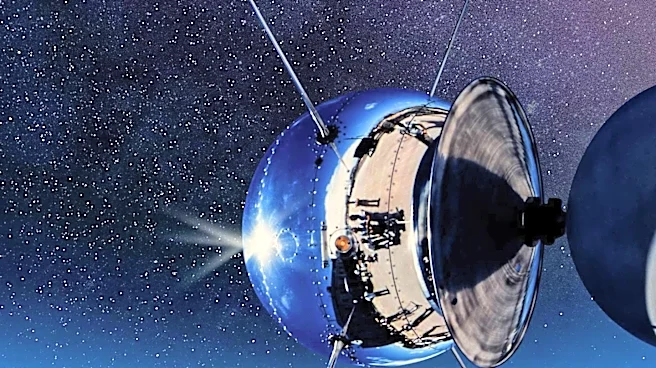







In 1966, NASA launched Lunar Orbiter 1, a groundbreaking mission that marked the United States' first successful attempt to orbit the Moon. This mission was not only a significant step in space exploration but also a testament to the technological innovations of its time. Designed to photograph the Moon's surface and gather critical data, Lunar Orbiter 1 faced numerous challenges that required innovative solutions.
Cutting-Edge Camera System
One of the most remarkable aspects
of Lunar Orbiter 1 was its camera system, developed by Eastman Kodak. Originally designed for the National Reconnaissance Office's SAMOS reconnaissance satellites, this camera system was adapted for lunar exploration. It featured a dual-lens setup with a 610 mm narrow-angle high-resolution lens and an 80 mm wide-angle medium-resolution lens. These lenses captured images on a single roll of 70 mm film, which was then developed onboard the spacecraft.
The film development process was a technological marvel in itself. After exposure, the film was processed, scanned, and transmitted back to Earth via a video signal. This innovative approach allowed Lunar Orbiter 1 to send back high-quality images of the Moon's surface, providing valuable data for future missions. Despite some early images showing severe smearing, the mission successfully captured 42 high-resolution and 187 medium-resolution frames.
Navigational Challenges and Solutions
Lunar Orbiter 1's journey to the Moon was not without its challenges. Shortly after launch, the spacecraft experienced a temporary failure of the Canopus star tracker, likely due to stray sunlight. This issue was resolved by using the Moon as a reference for navigation, showcasing the mission team's ability to adapt to unforeseen circumstances.
Another challenge was the spacecraft's overheating during its cruise to the Moon. To address this, the mission team oriented the spacecraft 36 degrees off-Sun, effectively lowering its temperature. These solutions demonstrated the ingenuity and problem-solving skills of the engineers and scientists involved in the mission.
Legacy of Innovation
Lunar Orbiter 1's technological innovations set the stage for future lunar exploration. The mission's success in capturing detailed images of the Moon's surface provided critical data for selecting landing sites for the Apollo and Surveyor missions. Additionally, the mission's orbit tracking data revealed new insights into the Moon's gravitational field.
The legacy of Lunar Orbiter 1 extends beyond its immediate achievements. It demonstrated the potential of space technology and inspired future missions to push the boundaries of what was possible. As a technological marvel of its time, Lunar Orbiter 1 remains a symbol of human ingenuity and the relentless pursuit of knowledge.