

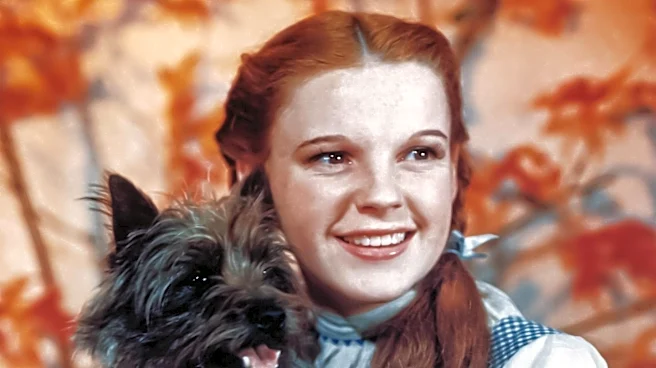
"The Wizard of Oz," the 1939 film classic, has achieved an unparalleled status as one of the most famous and cherished movies regularly shown on U.S. television. Its journey from a critical but modest financial success in theaters to a perennial television event is a testament to its enduring appeal. The film's television history is rich with groundbreaking broadcasts, celebrity hosts, and significant ratings, shaping how family-oriented fantasies
were presented on the small screen and solidifying its place in American popular culture.
The Groundbreaking 1956 Debut
The television debut of "The Wizard of Oz" on November 3, 1956, was a landmark event. Broadcast as part of the final program in CBS's "Ford Star Jubilee" anthology series, it marked the first time a Hollywood film was shown uncut in prime time on a coast-to-coast television network. This decision by CBS was a direct response to the successful color telecast of NBC's "Peter Pan" musical, ushering in a temporary trend of live, family-oriented fantasy specials on television. To accommodate the 101-minute film, the normally 90-minute "Ford Star Jubilee" was expanded to a full two hours, allowing for commercial breaks and celebrity-hosted segments.
For this historic broadcast, Bert Lahr, who famously played the Cowardly Lion in the film, co-hosted alongside Judy Garland's then 10-year-old daughter, Liza Minnelli, and Oz expert Justin G. Schiller. MGM sold the rights to CBS for $225,000, with an option for a re-broadcast at the same price if the initial telecast proved successful. This pioneering broadcast not only introduced the film to a vast new audience but also established a precedent for how classic movies would be presented on television for decades to come.
The Golden Age of Hosted Telecasts
Following its 1956 debut, "The Wizard of Oz" was not rebroadcast in 1957 or 1958. However, from 1959 until 1991 (with exceptions in 1963, 1992, and 1995), the film became an annual television tradition, always shown as a standalone TV special. This era was characterized by elaborate hosted segments featuring prominent CBS prime-time stars. Red Skelton hosted in 1959, followed by Richard Boone in 1960, Dick Van Dyke in 1961 and 1962, and Danny Kaye from 1964 through 1967. These hosts often brought their young children along, adding a family-friendly touch.
The hosting segments were imaginatively staged, not merely featuring a host standing in a studio. Richard Boone was taped on the set of his series "Have Gun – Will Travel," while Dick Van Dyke was shown in a living room set with his children. Danny Kaye's segment featured him on a prop toadstool against a painted backdrop of the Yellow Brick Road and Emerald City. Humor was often incorporated; Red Skelton appeared as a Victorian storyteller and then as himself, while Danny Kaye reassured viewers about the film starting in black-and-white and not to fear the MGM lion. The 1959 telecast, shown at an earlier hour, garnered a Nielsen rating of 36.5 and an audience share of 58%, solidifying its status as a television phenomenon. Media critic John Crosby famously remarked, "Television — any television — looks awfully ordinary after The Wizard of Oz."
"Wraparound" Credits and Color Broadcasting
Between 1959 and 1968, CBS presented "The Wizard of Oz" with elaborate videotaped "wraparound" opening and closing credits. These segments, accompanied by CBS's specially recorded music, featured the film's title and the names of its five leading actors in CBS's own format and font, read by an anonymous announcer who also introduced the sponsors. Notably, these CBS-devised credits never mentioned Metro-Goldwyn-Mayer, the film's production studio. While the film's original 1939 opening credits, including the MGM logo, were shown, the original closing cast list was omitted. Instead, after Dorothy's final line, CBS's own title card and cast list were displayed, followed by the host bidding farewell.
From its very first telecast in 1956, "The Wizard of Oz" was shown in color, a striking feature in an era dominated by black-and-white programming. The only exception was 1961, when sponsors declined to pay for a color broadcast. CBS, owned by a rival to RCA (which manufactured most color TVs), was initially reluctant to heavily promote color broadcasting. However, by the mid-1960s, color became a major part of network programming, and by the time the film moved to NBC in 1968, all network shows were in color.
Network Shifts and Enduring Popularity
In 1968, "The Wizard of Oz" moved from CBS to NBC, partly because CBS was unwilling to meet MGM's increased price for renewal. With this move, the tradition of regularly having hosts was largely dropped, and the film was shown with its original opening and closing credits. NBC also shifted the annual showings to the Easter and Passover seasons. The 1970 NBC telecast did feature a brief segment with Gregory Peck paying tribute to the recently deceased Judy Garland. CBS, realizing its error, bought back the rights in 1976 at MGM's asking price, leading to a significant boost in their viewer ratings, with one executive remarking the film was "better [for the network] than a gushing oil well."
Angela Lansbury hosted a filmed segment in 1990, and a documentary about the film's making, "The Wonderful Wizard of Oz: 50 Years of Magic," was shown immediately after that telecast. In later years, the film found new homes on cable channels like Turner Classic Movies, often with hosts like Robert Osborne, Tom Kenny, and Bill Hader. While minor cuts were made between 1968 and 1984 to accommodate commercials, and some time-compression occurred in 1985, "The Wizard of Oz" is now typically shown complete and at its regular speed, running about two hours and fifteen minutes with advertisements. Its consistent high ratings, often beating competing programs like Disney specials, underscore its unparalleled and enduring status as a television classic.