

Anjali Mudra is a hand gesture deeply embedded in Indian religions and arts, found across Asia. It is a prominent feature in Indian classical dance, such as Bharatanatyam, and is commonly incorporated into yoga practice. This gesture also forms a part of the greeting *namaste*. As a form of non-verbal, visual communication, Anjali Mudra is one of the 24 *samyukta mudras* in Indian classical arts. It is widely used as a sign of respect or a silent
greeting in India and other parts of Asia, and is also practiced by East Asian Buddhists, Chinese religionists, Shintoists, and adherents of similar Asian traditions.
Etymology and Historical Context of Anjali Mudra
The Sanskrit word *Anjali* refers to the cavity formed between the palms when hands are folded together, traditionally used to hold and offer flowers or water, or to give or receive something. When the hands are pressed together and raised, the gesture conveys respect, reverence, benediction, salutation, or supplication. The word is derived from *anj*, meaning "to honor or celebrate," and *Anjali* itself connotes a "divine offering" or "a gesture of reverence." *Mudra* means "seal" or "sign," making the phrase *Anjali Mudra* translate to "salutation seal."
Ancient Indian texts describe Anjali Mudra, including verses 9.127–128 of the *Natya Shastra* (dating from 200 BCE to 200 CE), and texts on temple architecture from after the 6th century CE, such as verse 5.67 of the *Devatamurtiprakarana* and the *Citrasutras* on painting. The *Natya Shastra*, a classical Indian dance text, describes it as a reverential posture for prayer before a deity, for receiving revered individuals, and for greeting friends. It specifies that for temple prayers, Anjali Mudra should be placed near or above the head; for venerable individuals, in front of the face or chin; and for friends, near the chest. The gesture is also known as *hrdayanjali mudra*, meaning "reverence to the heart seal," and *atmanjali mudra*, meaning "reverence to the self seal."
Performing and Symbolizing Anjali Mudra
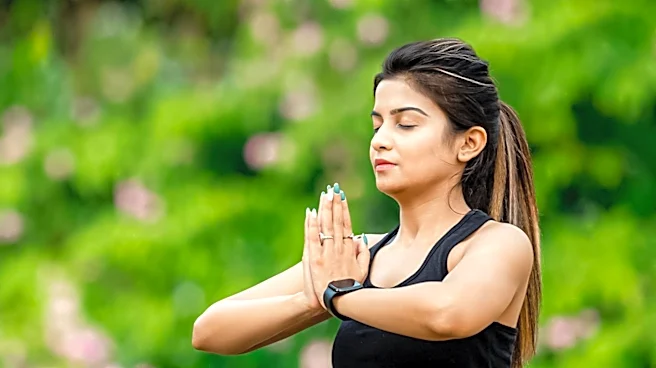
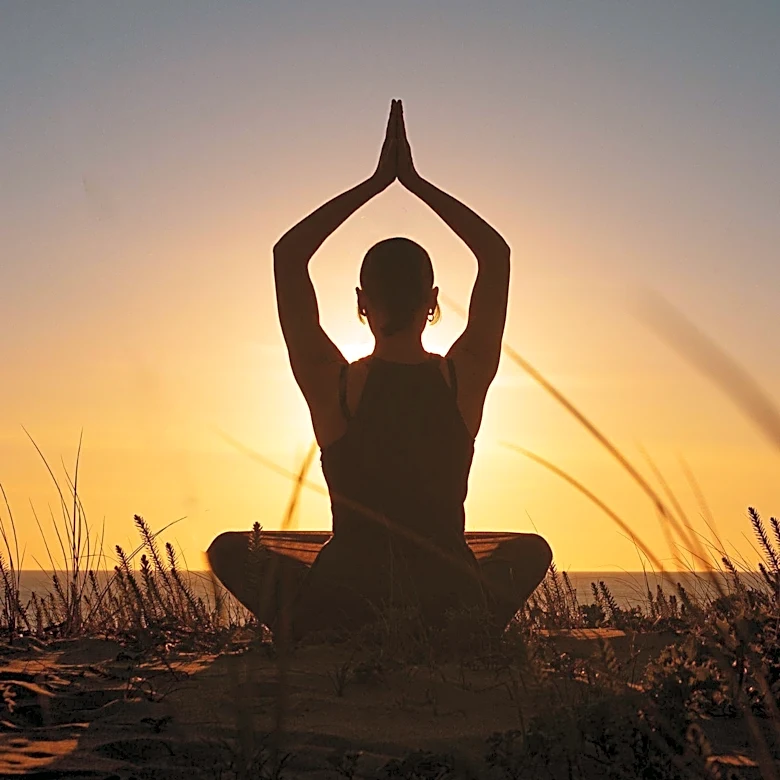
Anjali Mudra is performed by pressing the palms firmly and evenly together, with fingers joined and fingertips pointing upward. In its most common form, the hands are held at the heart chakra, with the thumbs gently resting against the sternum. It can also be performed at the Ajna or brow chakra, with thumbtips touching the "third eye," or at the crown chakra, above the head. In some yoga postures, the hands are placed in Anjali Mudra to one side of the body or behind the back. The gesture is typically accompanied by a slight bowing of the head.
Symbolically, Anjali Mudra shares meaning with the Sanskrit greeting *namaste* and can be performed while saying *namaste* or *pranama*, or as a substitute for vocalizing the word. It is used for both greetings and farewells, carrying a deeper significance than a simple "hello" or "goodbye." The joining of the palms is believed to connect the brain's right and left hemispheres, representing unification. This yoking symbolizes the practitioner's connection with the divine in all things. The word *namaste* is sometimes translated as "I bow to the divinity within you, from the divinity within me." In Sri Lanka, the Sinhalese greeting *ayubowan* (may you live long) incorporates this gesture, with both hands placed together on the sternum along with a slight bow.