





The STS-41-G mission, launched on October 5, 1984, aboard the Space Shuttle Challenger, was far more than just a crewed flight; it was a sophisticated platform for advanced scientific research and technological demonstrations. As the 13th flight of NASA's Space Shuttle program, this mission carried a diverse array of payloads and experiments designed to expand humanity's understanding of Earth's environment, test new space technologies, and conduct
fundamental research in various scientific disciplines. From satellite deployment to radar imaging and in-orbit refueling demonstrations, STS-41-G showcased the multifaceted capabilities of the Space Shuttle system.
Earth Observation and Satellite Deployment
A primary objective of STS-41-G was the deployment of the Earth Radiation Budget Satellite (ERBS). Nine hours after liftoff, this 2,307 kg (5,086 lb) satellite was successfully deployed from the Challenger's payload bay using the Canadarm robot arm. Its on-board thrusters then boosted it into its operational orbit, approximately 560 km (350 mi) above the Earth. The ERBS was the first of three planned satellites intended to measure the amount of energy received from the Sun and subsequently reradiated into space. It also played a crucial role in studying the seasonal movement of energy from the tropics to the polar regions, providing vital data for climate science.
Another significant component of the mission's Earth observation efforts was the operation of the Shuttle Imaging Radar-B (SIR-B). This advanced radar system was part of the OSTA-3 experiment package, which was housed in the payload bay. The SIR-B was an improved version of a similar device that had flown on the OSTA-1 package during the STS-2 mission. It featured an impressive eight-panel antenna array, measuring 11 by 2 meters (36.1 by 6.6 feet). Although problems were encountered with Challenger's Ku-band antenna, necessitating much of the data to be recorded on board rather than transmitted in real-time, the SIR-B operated throughout the flight, collecting valuable radar imagery.
Comprehensive Experimentation and In-Orbit Demonstrations
The OSTA-3 experiment package extended beyond the SIR-B, incorporating other instruments for detailed Earth observation. It included the Large Format Camera (LFC), designed to photograph the Earth with high resolution, and another camera named MAPS, which was used to measure air pollution. Additionally, a feature identification and location experiment (FILE) was part of the package, comprising two TV cameras and two 70 mm (2.8 inch) still cameras, further enhancing the mission's ability to gather visual data about our planet.
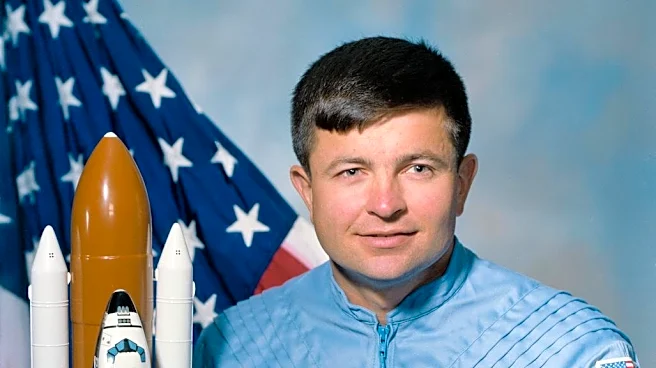
Beyond Earth observation, STS-41-G featured critical in-orbit demonstrations. Kathryn D. Sullivan and David C. Leestma performed a 3-hour Extravehicular Activity (EVA) on October 11, 1984. During this spacewalk, Sullivan became the first American woman to walk in space. Their primary task was to demonstrate the Orbital Refueling System (ORS), successfully proving the feasibility of refueling satellites in orbit. This capability was a significant step towards extending the operational life of satellites and reducing the need for costly replacement missions.
Diverse Scientific Contributions and Mission Legacy
The scientific breadth of STS-41-G was further enriched by the contributions of its payload specialists. Paul D. Scully-Power, an employee of the U.S. Naval Research Laboratory, conducted a series of oceanography observations, leveraging the unique vantage point of space to study marine phenomena. Marc Garneau, the first Canadian astronaut, carried out a series of experiments sponsored by the Canadian government, known as CANEX. These experiments spanned medical, atmospheric, climatic, materials, and robotic science, highlighting international collaboration in space research. A variety of Getaway Special (GAS) canisters, containing diverse materials testing and physics experiments, were also flown, demonstrating the shuttle's versatility as a research platform.
Over its 8-day, 5-hour, 23-minute, and 33-second duration, Challenger traveled over 5.2 million kilometers and completed 133 orbits. The mission concluded with a successful landing at the Kennedy Space Center. The extensive scientific data collected and the technological demonstrations performed during STS-41-G provided invaluable insights and laid groundwork for future space missions, solidifying its place as a highly productive and pioneering flight in the Space Shuttle program.