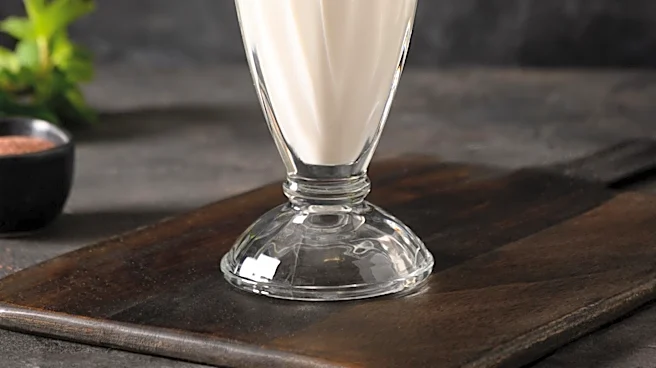







The milkshake, a sweet and thick beverage made from milk, ice cream, and various flavorings, has a rich history deeply rooted in the United States. While today it's a ubiquitous treat, its form and cultural significance have evolved considerably since its first appearance in print in 1885. Initially, the term "milkshake" referred to a very different kind of drink, highlighting a fascinating transformation that paralleled technological advancements
and changing social customs in America.
From Alcoholic Tonic to Wholesome Treat
When the term "milkshake" first appeared in print in 1885, it described an alcoholic whiskey drink. This early version was characterized as a "sturdy, healthful eggnog type of drink," often containing eggs and whiskey, and served as both a tonic and a treat. This initial definition stands in stark contrast to the family-friendly beverage we know today. However, by 1900, the meaning of the term had shifted dramatically. It began to refer to "wholesome drinks made with chocolate, strawberry, or vanilla syrups," indicating a move away from its alcoholic origins and towards a sweeter, non-alcoholic concoction.
By the early 1900s, people were increasingly requesting this new treat, often with the addition of ice cream. This period marked a crucial transition, as ice cream became an integral component of what would become the modern milkshake. The 1930s saw milkshakes solidify their popularity, becoming a standard offering at malt shops, which were the typical soda fountains of that era. These establishments served as important social gathering spots, further embedding the milkshake into American youth culture.
The Interconnected Histories of Blenders and Malted Milk
The evolution of the milkshake is closely tied to the development of electric blenders and the popularization of malted milk. Before electric blenders became widely available, milkshake-type drinks were more akin to eggnog or were simply hand-shaken mixtures of crushed ice, milk, sugar, and flavorings. The introduction of the Hamilton Beach Cyclone Drink Mixer in 1911 was a significant turning point. This appliance was widely adopted in soda fountains, making the preparation of whipped, aerated, and frothy milkshakes possible.
In 1922, Steven Poplawski invented the bottom-motor blender, another innovation that contributed to milkshake production. The Hamilton Beach design, with its motor on top, remains the most common type of milkshake machine used today. These inventions were crucial in transforming the milkshake into its modern form, allowing for the characteristic smooth and thick texture that defines the beverage.
Walgreens and the Rise of the "Malted"
The Chicago drugstore chain Walgreens played a pivotal role in popularizing the use of malted milk powder in milkshakes across the U.S. Malted milk powder, a blend of evaporated milk, malted barley, and wheat flour, was originally invented by William Horlick in 1897. It was intended as an easily digestible restorative health drink for disabled people and children, and also as an infant's food. However, its pleasant taste soon led healthy individuals to consume beverages made with malted milk simply for enjoyment.
Malted milk beverages, typically containing milk, chocolate syrup, and malt powder, became a standard item at soda fountains. A significant moment occurred in 1922 when Walgreens employee Ivar "Pop" Coulson added two scoops of vanilla ice cream to the standard malted milk drink recipe. This new creation, initially featured by Walgreens under the name "Horlick's Malted Milk," quickly became known as a "malted" or "malt." It rapidly grew into one of the most popular soda-fountain drinks, cementing the malted milkshake's place in American culinary history.
Automation and Cultural Symbolism
The automation of milkshake production advanced in the 1930s, spurred by the invention of Freon-cooled refrigerators. These refrigerators provided a safe and reliable method for automatically making and dispensing ice cream. In 1936, inventor Earl Prince utilized this concept to develop the Multimixer, a five-spindled mixer capable of producing five milkshakes simultaneously and automatically dispensing them into paper cups with the pull of a lever.
During the decades following the introduction of electric blenders, ice cream shops became popular social gathering spots for young people. Milkshakes, in this context, came to symbolize the simplicity and innocence of youth culture. Newspaper articles from the late 1930s also show that the term "frosted" was sometimes used to refer to milkshakes, especially those made with ice cream. For example, a 1937 article in the Denton Journal in Maryland stated, "For a 'frosted' shake, add a dash of your favorite ice cream," further illustrating the evolving terminology and popularity of these cold, sweet treats.