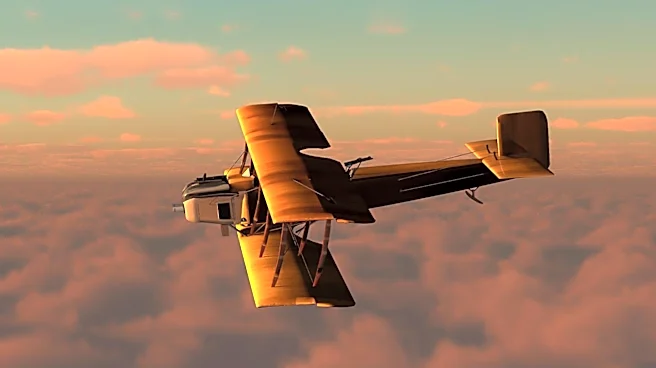







The story of the Wright Flyer III is one of perseverance, marked by early struggles and a determined pursuit of reliability in flight. Built by the Wright Brothers in 1904–05, this aircraft initially mirrored the marginal performance of its predecessors. However, a pivotal crash and the subsequent meticulous redesign transformed it into a practical and dependable flying machine. This journey from instability to control highlights the Wrights' iterative
approach to engineering, where every setback became an opportunity for significant improvement.
Early Flights and a Critical Crash
Orville Wright made the inaugural flight of the Flyer III on June 23, 1905. At first, the aircraft's appearance and performance were quite similar to the earlier Flyer I and Flyer II. It featured a spruce construction and a wing camber of 1-in-20, a design choice that had been used successfully in 1903. The machine also incorporated the engine and other hardware from the scrapped Flyer II, with the expectation of improved performance. However, the initial design still harbored significant stability issues.
These issues came to a head on July 14, 1905, when Orville experienced a serious nose-dive crash, sustaining minor injuries. This incident was a stark reminder of the inherent instability that had plagued their previous models. Rather than abandoning the project, the Wrights viewed this crash as a critical learning experience. It prompted them to undertake a comprehensive rebuilding effort, during which they implemented crucial design changes aimed at fundamentally solving the stability problems that had hindered their progress.
Redesigning for Stability and Control
The rebuilding of the Flyer III after the July 1905 crash was a turning point. The Wrights introduced several significant modifications to enhance stability and control. They nearly doubled the size of both the elevator and the rudder, and critically, moved these control surfaces approximately twice the distance from the wings. This increased distance provided greater leverage and more effective control over the aircraft's pitch and yaw.
Further refinements included the addition of two fixed half-moon shaped vertical vanes, known as "blinkers," between the elevators, although these were later removed. The skid-undercarriage was also widened, which subtly contributed to the wings having a very slight dihedral, improving lateral stability. A major innovation in the control system was the disconnection of the rear rudder from the wing-warping control. This allowed the rudder to be operated independently with its own control handle, a design choice that would become a standard in future aircraft, offering pilots more precise directional control.
The Triumph of Dependable Flight
When testing resumed in September, the impact of these design changes was immediately apparent. The persistent pitch instability that had made earlier flights so challenging was finally brought under control. The frequent crashes, some of which had been severe, ceased to occur. Flights with the redesigned Flyer III began to last over 20 minutes, a significant leap in endurance and reliability.
The Flyer III had evolved into a practical and dependable aircraft. It could fly reliably for extended durations, consistently bringing its pilot back to the starting point safely and landing without damage. This newfound reliability was dramatically demonstrated on October 5, 1905, when Wilbur Wright completed a circling flight of 24.2 miles (38.9 kilometers) in 39 minutes and 23 seconds over Huffman Prairie. This single flight surpassed the total duration of all flights made in both 1903 and 1904, solidifying the Flyer III's status as a truly successful and practical flying machine.