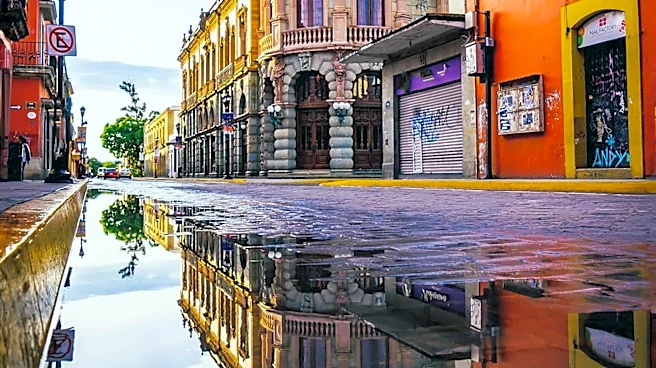







Oaxaca City, known in Spanish as Oaxaca de Juárez, is a vibrant hub of culture and history in Mexico. Beyond its designation as a UNESCO World Heritage Site, the city boasts an impressive array of museums and a historic theater that collectively tell the story of its rich past and artistic present. From ancient Zapotec and Mixtec treasures to contemporary art and the legacy of national heroes, Oaxaca's cultural institutions offer a deep dive into
the region's heritage, making it a significant destination for those interested in Mexican art, history, and traditions.
The Centro Cultural de Santo Domingo: A Monument to Oaxacan Heritage
At the heart of Oaxaca's cultural scene is the Centro Cultural de Santo Domingo, housed within the former monastery buildings attached to the Santo Domingo church. These buildings underwent a significant restoration in 1996, a project widely regarded as one of the finest restoration efforts in Latin America. The Centro Cultural features a grand courtyard with a fountain and a large staircase, surrounded by passages with vaulted ceilings, cupolas, and intricate corridors, showcasing remarkable architectural detail.
A substantial portion of the Centro Cultural is dedicated to the Museo de las Culturas de Oaxaca (Museum of Oaxacan Cultures). This museum, which moved into the Centro Cultural in 1964, specializes in the Zapotec and Mixtec cultures, spanning ten halls and an auditorium. A highlight of the museum is Sala III, which displays the "Tesoro Mixteco" (Mixtec Treasure). This collection comprises hundreds of gold and silver jewelry pieces discovered by archaeologist Alfonso Caso in Tomb 7 of Monte Albán, representing the richest collection of ancient Mexican gold and silver smithing. Other notable exhibits include objects from Tomb 5 of Lambitieco, dating back to 700 C.E., and items from Monte Albán. The museum also features rooms dedicated to everyday colonial-period items. Within the center is also the Biblioteca Fray Francisco de Burgoa (Fray Francisco de Burgoa Library), which preserves over 25,000 degrees conferred from the 15th to the 20th century by the Universidad Autónoma Benito Juárez in Oaxaca.
Showcasing Oaxacan Art: From Ancient to Contemporary
Oaxaca City is a haven for art enthusiasts, with several institutions dedicated to showcasing both ancient and modern artistic expressions. The Museum of Contemporary Art (Museo de Arte Contemporáneo de Oaxaca, MACO) is located in the historic Casa de Cortés, one of the city's oldest and most representative non-religious buildings. Although it dates from after Hernán Cortés's death, its architecture, a blend of Andalusian style with Oaxacan traditions, is notable. The building retains its original layout of rooms surrounding three courtyards, with a two-level facade featuring wrought-iron railings. Its Spanish Baroque portal is particularly striking, with three levels adorned with columns, balconies, a Jesuit seal, and sculptures. The state of Oaxaca acquired the house, and after initially housing the Museo Historico Urbano de Oaxaca in 1986, it became MACO, featuring works by Rufino Tamayo, Francisco Toledo, and others.
The Museo de los Pintores Oaxaqueños (Museum of Oaxacan Painters), situated in an 18th-century mansion, focuses on local artists. It permanently displays works by Rodolfo Morales and has featured exhibitions by artists such as Felipe Morales, Rodolfo Nieto, Alejandro Santiago, and Francisco Toledo. Another significant art institution is the Rufino Tamayo Museum (Museo Arte Prehispánico de Rufino Tamayo). Painter Rufino Tamayo donated his extensive collection of pre-Hispanic art, along with the 18th-century Casa de Villanaza that now houses the museum, to his home state in 1974. The museum exhibits over 1150 pieces from various Mesoamerican periods, including Mayan steles, ceramic dogs from Colima, and stone faces from the Gulf of Mexico coast, emphasizing their aesthetic and cultural value.
Historical Residences and Specialized Collections
Beyond grand museums, Oaxaca City offers more intimate glimpses into its past through historical residences turned museums and specialized collections. The Casa de Juárez is a museum dedicated to the life of Benito Juárez, who lived there from 1818 to 1828 after arriving from Guelatao. The museum contains documents related to his presidency and furnishings that recreate the period's environment, housed in an 18th-century home typical of the city. It also displays ordinary artifacts from that era, some of which belonged to Juárez.
Specialized museums further enrich the city's cultural landscape. The Religious Museum of the Ex monastery of La Soledad, located next to the Basilica of La Soledad, houses paintings, sculptures, and vestments. The Instituto de Artes Gráficos de Oaxaca (Graphic Arts Institute of Oaxaca) boasts an extensive collection of graphic designs, both historical and contemporary. Additionally, the Hemeroteca Publica de Oaxaca "Nestor Sánchez" (Nestor Sanchez Public Newspaper Library of Oaxaca) and the Jardin Ethobotánico (Ethnobotanic Garden) occupy over two hectares behind the ex-convent of Santo Domingo, once the convent's gardens.
The Grandeur of Teatro Macedonio Alcalá
Oaxaca's cultural offerings extend to the performing arts with the magnificent Teatro Macedonio Alcalá. Built between 1903 and 1909, this working theater also houses a collection of romantic art. Its design is characteristic of the Porfirio Díaz era, marking the transition from the 19th to the 20th century. Originally named the Luis Mier y Terán Theater and later the Jesús Carranza Theater, it received its current name in 1932, honoring the composer of the state anthem, "Dios Nunca Muere" (God Never Dies).
The theater is divided into three main parts: the vestibule, the main hall, and the stage. Its main entrance is at a corner, while the lower level along Armenta and López Street houses shops and the Miguel Cabrera Salon, which hosts art exhibits. The vestibule is designed in a Louis XV style with a white marble staircase, and the main hall features an "Imperial" style, notable for its anthropomorphic columns. Other cultural points of interest in Oaxaca City include the Alvarez Bravo Photography Center, the Oaxaca Stamp Museum, the Railway Museum of Southern Mexico (located in the old train station), and the Planetarium on the Cerro del Fortín, all contributing to the city's vibrant cultural identity.