






The New York Rangers, a cornerstone of the National Hockey League, trace their origins back to 1926, a period marked by ambition and rapid expansion in professional hockey. The team's creation was spearheaded by George Lewis "Tex" Rickard, the president of Madison Square Garden, who saw an opportunity to capitalize on the unexpected success of another New York team, the Americans. Despite an earlier promise that the Americans would be the sole hockey tenant
at the Garden, Rickard pursued and secured his own franchise, laying the groundwork for one of the NHL's most storied organizations. This early history is characterized by swift success, including multiple Stanley Cup victories within the team's first decade and a half.
Founding and Naming the Franchise
Tex Rickard's drive to establish a second NHL team in New York was a direct response to the New York Americans' strong inaugural season in 1925–26. The Americans' popularity at Madison Square Garden demonstrated a clear demand for professional hockey in the city. On April 17, 1926, during a league meeting with NHL president Frank Calder, Rickard's franchise was initially incorporated as the "New York Giants Professional Hockey Club." However, the name was quickly changed to the "New York Rangers Hockey Club" during the same meeting. The now-iconic nickname "Rangers" is attributed to George Haley, the sports editor of the New York Herald Tribune, who famously dubbed the new team "Tex's Rangers," a playful nod to Rickard's involvement.
To assemble the team, Conn Smythe, who would later become a prominent figure with the Toronto Maple Leafs, was hired as manager-coach. Smythe's approach to team building was unique for the time. Unlike other expansion teams, such as the Detroit Cougars and Chicago Black Hawks, who purchased entire rosters from the defunct Western Hockey League, Smythe opted to sign what he considered the best individual players from the remaining WHL teams and a few overlooked NHL players. This strategy proved effective, though Smythe himself had a falling-out with Rickard's associate, John S. Hammond, and was fired on the eve of the first season. He was compensated with a substantial $2,500 to leave, and Lester Patrick, a co-founder of the Pacific Coast Hockey Association, took over as his replacement, retaining the roster Smythe had built.
Rapid Ascent to Stanley Cup Champions
The team Smythe assembled, and Patrick coached, quickly proved to be a winner. In their very first season, 1926–27, the Rangers won the American Division title, though they ultimately lost to the Boston Bruins in the playoffs. This early success was a harbinger of greater achievements to come. The team's performance on the ice quickly translated into cultural prominence, with players becoming minor celebrities and integral parts of New York City's vibrant "Roaring Twenties" nightlife. It was during this era, playing at the Garden on 49th Street, close to Times Square, that the team earned its enduring nickname, "The Broadway Blueshirts."
The Rangers' most significant early triumph came in only their second season. Under the guidance of Lester Patrick, and featuring key players like Frank Boucher, Murray Murdoch, and the brothers Bun and Bill Cook, the team captured the Stanley Cup in 1928. This victory was historic, marking the first time an NHL franchise from the United States won the coveted trophy. The Rangers also hold the distinction of being the fastest true expansion team in NHL history to achieve this feat. Their success continued into the 1930s, with a second Stanley Cup win in the 1932–33 season, where they defeated the Toronto Maple Leafs three games to one in the best-of-five finals. This win was particularly sweet, serving as revenge against the Leafs' formidable "Kid line." The team secured its third Stanley Cup in the 1939–40 season, overcoming the Boston Bruins in the first round and then defeating the Toronto Maple Leafs in six games in the finals. This period of early dominance established the New York Rangers as a formidable force in the nascent NHL.
The Original Six Era and Beyond
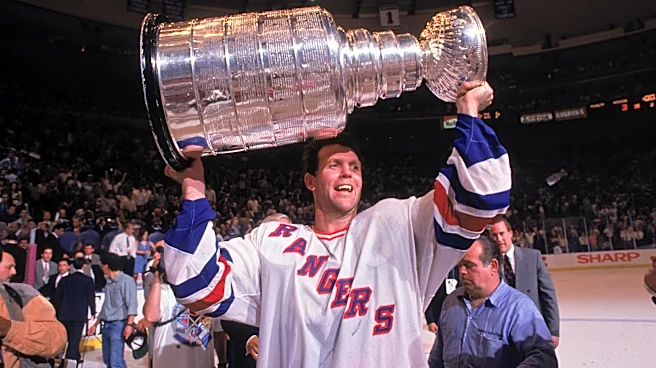
The Rangers were one of the "Original Six" teams that competed in the NHL before its significant expansion in 1967, alongside the Boston Bruins, Chicago Blackhawks, Detroit Red Wings, Montreal Canadiens, and Toronto Maple Leafs. Their early success, however, was followed by a challenging period. After their 1940 Stanley Cup win, the team entered a prolonged championship drought that would famously become known as the "Curse of 1940." This curse, attributed by some to the burning of the Madison Square Garden mortgage in the Stanley Cup bowl or to a vow by Red Dutton after the New York Americans folded, would last for 54 years. Despite this long drought, the Rangers' foundational years established a legacy of early triumph and set the stage for their enduring presence in the NHL.
During the 1930s, the team also made history in other ways, becoming the first NHL team to travel by plane on December 13, 1929, when they flew to Toronto for a game against the Maple Leafs. This early period of innovation and success cemented the Rangers' place in hockey history, even as future challenges awaited them in the Original Six era.