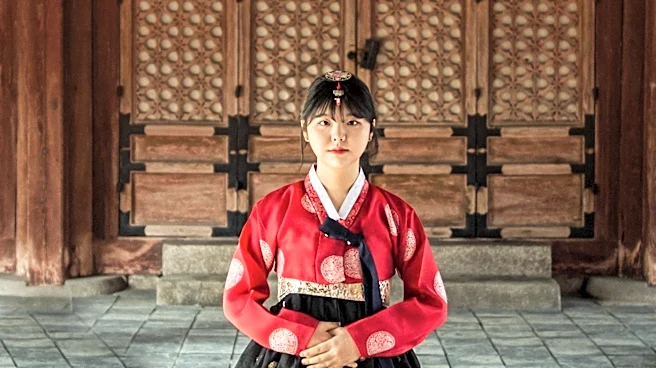








Hanbok, the traditional Korean attire, has a long and dynamic history, marked not only by indigenous developments but also by significant influences from neighboring cultures. While its fundamental structure traces back to nomadic clothing of the Eurasian Steppes, the evolution of hanbok has been shaped by interactions with various empires, particularly China's Tang and Song dynasties, and the Mongol Empire. These cultural exchanges introduced new
styles, materials, and customs that were integrated into Korean fashion, reflecting periods of both political alliance and foreign domination.
Tang Dynasty's Impact on Silla and Balhae
The Three Kingdoms period saw the earliest visual depictions of hanbok, but the Unified Silla period (668-935 CE) marked a significant era of cultural exchange. After Silla unified the Three Kingdoms in 668 CE, its court began to adopt elements from the Tang dynasty of China. In 664 CE, Munmu of Silla decreed that the queen's costume should resemble Tang dynasty attire, leading to women's clothing accepting Tang cultural influences. Women in Silla sought to imitate Tang styles by adopting shoulder straps attached to their skirts and wearing skirts over their *jeogori* (jackets). The Tang court dress regulations were adopted in the Silla court, making its attire extravagant. However, this extravagance led King Heundeog to enforce a prohibition on Tang clothing in 834 CE. Despite this, the general public of Silla continued to wear their traditional clothing.
Balhae (698–926 CE), a kingdom founded in Manchuria by Goguryeo refugees and Mohe people, also experienced Tang influence. While early Balhae officials continued the Three Kingdoms period tradition in clothing, after Mun of Balhae, the kingdom began incorporating Tang elements like the *putou* (headwear) and round-collared gowns for official attire. Balhae's clothing culture was heterogeneous, influenced by Tang, Goguryeo, and indigenous Mohe elements. Balhae imported silks and cotton from Tang and various items from Japan, while exporting fur and leather.
Mongolian Fashion and the Goryeo Dynasty
The Goryeo dynasty witnessed profound changes in hanbok, particularly under Mongol rule following a peace treaty with the Mongol Empire in the 13th century. Mongolian princesses marrying into the Korean royal house introduced Mongolian fashion, which became prevalent in both formal and private life. Seven women from the Yuan imperial family married Goryeo kings, and these princesses were instructed to maintain Yuan traditions, including clothing. Consequently, Yuan clothing was worn in the Goryeo court and influenced the upper-class families who visited it. This Yuan clothing culture, which affected the upper classes and to some extent the general public, was known as *Mongolpung*.
King Chungryeol, as an imperial son-in-law of the Mongol Empire, even issued a royal edict directing the aristocracy to adopt Mongol clothing. As a result of this influence, the *chima* (skirt) was shortened, and the *jeogori* was hiked up above the waist, tied at the chest with a long, wide ribbon called a *goreum*, replacing the earlier sash-like *twii*. Sleeves also became slightly curved. After the fall of the Yuan dynasty, only beneficial and suitable Mongol clothing elements were retained in Goryeo culture, while others disappeared.
Bilateral Exchange and Goryeoyang
The cultural exchange was not one-sided. Goryeo also influenced the Mongol court of the Yuan dynasty, particularly through the *Goryeoyang* ("the Goryeo style"). This influence, especially on the attire of aristocrats, queens, and concubines, occurred in the capital city, Khanbaliq, mainly in the later years of the Yuan dynasty. Empress Gi, a Goryeo-born woman who became the last Empress of the Yuan dynasty, played a significant role in popularizing *Goryeoyang*. Her influence and the large number of Goryeo court ladies she employed led to a craze where acquiring a Goryeo woman became a status symbol, and