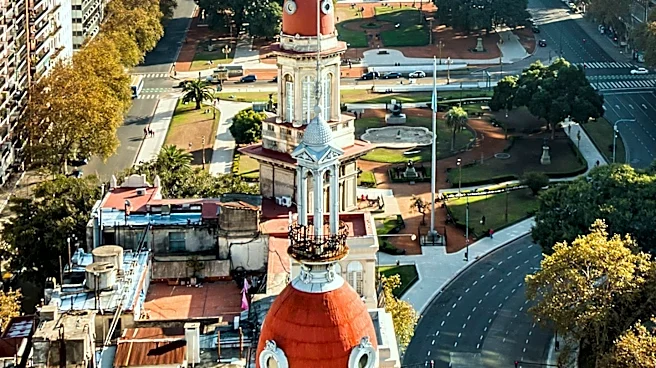









Greater Buenos Aires, also known as the Buenos Aires Metropolitan Area (AMBA), represents a vast urban agglomeration that includes the Autonomous City of Buenos Aires and 24 adjacent partidos (counties) within the Province of Buenos Aires. This sprawling region, often referred to as the "Conurbano," does not constitute a single administrative unit but rather a complex network of interconnected municipalities. Its development is marked by a significant
historical event: the federalization of the city of Buenos Aires in 1880, which separated it from the province that bears its name. This separation set the stage for the unique administrative and demographic evolution of both the city and the surrounding metropolitan area.
The Genesis of a Metropolitan Area
The term "Gran Buenos Aires" (Greater Buenos Aires) was officially recognized in 1948. This designation came about when Domingo Mercante, then Governor of Buenos Aires Province, signed legislation that defined an area encompassing 14 municipalities surrounding the City of Buenos Aires. This formal recognition highlighted the growing urban sprawl that had begun to characterize the region. The city of Buenos Aires, once the capital of the province, became an autonomous entity, while the province established its new capital in La Plata in 1882.
Despite the administrative separation, the city and its surrounding areas remained intrinsically linked, forming a functional urban core. The province, though no longer containing the capital city, continued to grow around it, particularly in the areas that would eventually form the Greater Buenos Aires metropolitan region. This historical context is crucial for understanding the current structure and dynamics of one of South America's largest urban centers.
Rapid Urbanization and Demographic Shifts
The period between 1945 and 1980 witnessed an intense phase of urban sprawl, transforming the region into a massive metropolitan area covering over 3,800 square kilometers (1,500 mi²). This expansion was approximately 19 times the area of Buenos Aires proper. The 24 suburban partidos experienced remarkable population growth, increasing more than sixfold between the 1947 and 2022 censuses. This translates to an annual growth rate of nearly 2.5% for the suburban area, significantly higher than the national average of 1.4% during the same period.
By 2022, the total population of the entire 30-county area, including the City of Buenos Aires (with 3 million inhabitants), reached 12 million. This vast population accounts for a third of Argentina's total population and generates nearly half (48%) of the country's Gross Domestic Product (GDP). While the annual growth rate for the suburban area slowed to 0.8% between 2010 and 2022, the metropolitan region continued to expand. In 2006, Law 13473 officially added six more partially urbanized partidos, with a combined population of 1,062,991 as of the 2022 census, to the metropolitan area. This law also incorporated the neighboring Greater La Plata's population of 938,287 into the total, further solidifying Greater Buenos Aires's status as a demographic and economic powerhouse.