

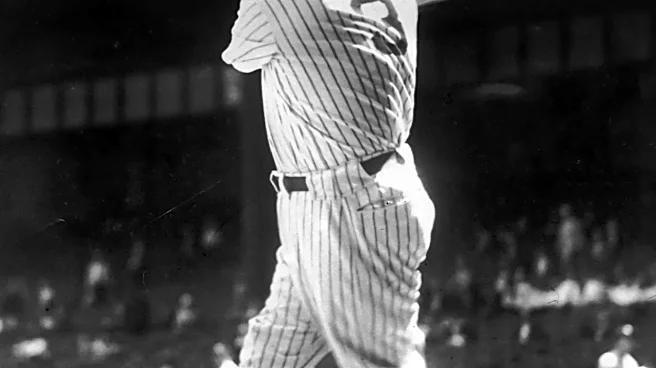

Jimmie Foxx, a name synonymous with power hitting in baseball history, embarked on a professional career that would see him become one of the sport's most formidable figures. His journey began with the Philadelphia Athletics in 1925, where he quickly transitioned from a backup role to a dominant force. Over his illustrious career, Foxx would achieve numerous milestones, including a Triple Crown, multiple MVP awards, and a place among the game's all-time
home run leaders, solidifying his legacy as a true legend of the diamond.
Early Days and Positional Shift
Jimmie Foxx made his Major League Baseball (MLB) debut on May 1, 1925, with the Philadelphia Athletics. Initially, Foxx had aspirations of pitching or playing third base, but the team's need for catchers led him behind the plate, a position he had experience with from high school and summer all-star teams. His first career hit came off pitcher Vean Gregg. In June of that debut season, Athletics owner Connie Mack opted to send Foxx to the Providence Grays. This move was intended to provide him with more playing time and opportunities to develop his hitting skills at a higher level, rather than having him sit on the bench at Shibe Park.
The following season, Foxx saw a slight increase in his appearances, primarily serving as a pinch hitter or a replacement catcher. By 1927, he signed a contract for $3,000, an amount equivalent to $56,359 in 2025. Despite this, he remained in a backup capacity because Mickey Cochrane, a future Baseball Hall of Fame member, was the primary catcher. It was during this period that Foxx began his transition to first base, a move that would ultimately define his career. On May 31, 1927, he hit his first home run against Urban Shocker of the New York Yankees, and he concluded that season batting an impressive .323 over 61 games.
Ascension to Dominance and Record-Setting Power
As Foxx settled into his role, his hitting prowess became undeniable. He quickly established himself as one of baseball's greatest hitters, a reputation he would maintain throughout his career. His exceptional talent was recognized early on, leading him to become the ninth player in history to achieve the coveted Triple Crown, a testament to his all-around offensive skill in batting average, home runs, and runs batted in. Furthermore, Foxx set a then-record for the most Most Valuable Player (MVP) awards, securing three during his time in the league.
The 1932 season stands out as a particularly remarkable year for Foxx. He blasted 58 home runs, a total that, at the time, ranked as the third-most all-time in a single season. Beyond just home runs, his overall offensive production was staggering; he collected 438 total bases that same season, a figure that remains the fifth-most all-time. Foxx's ability to accumulate such high total bases was not a one-off event, as he is one of only seven batters in baseball history to achieve over 400 total bases in a season more than once, underscoring his consistent and powerful hitting.
A Legacy of Unmatched Hitting Statistics
Jimmie Foxx's career was marked by sustained excellence at the plate. He claimed two American League (AL) batting titles and led all of baseball in home runs on four separate occasions. His consistency was further highlighted by the fact that he batted over .300 in eleven full seasons, a remarkable display of sustained offensive output. On September 24, 1940, Foxx etched his name further into the record books by becoming the second member of the exclusive 500 home run club, hitting a sixth-inning home run off George Caster.
For nearly 67 years, Foxx held the distinction of being the youngest major leaguer to reach the 500 home run milestone, a testament to his early and enduring power. His career totals are still highly ranked in baseball history; his 534 home runs currently place him 19th all-time, and his 1,922 runs batted in (RBI) rank him tenth all-time. With an impressive career batting average of .325 and a slugging percentage of .609, Jimmie Foxx's extraordinary contributions to the sport were recognized with his election to the National Baseball Hall of Fame in 1951, cementing his status as one of the game's truly legendary hitters.