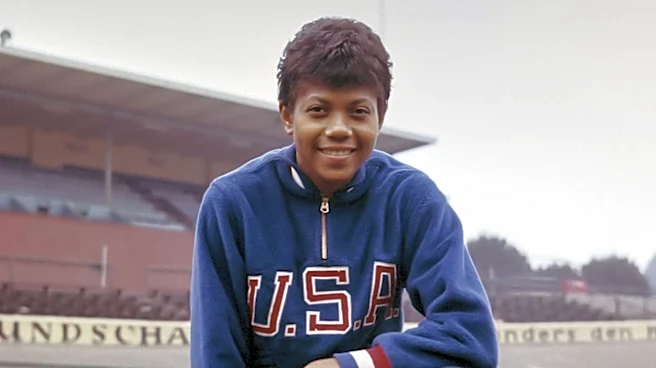







Wilma Rudolph emerged as a dominant force in track and field during the late 1950s and early 1960s, earning international acclaim for her speed and grace. Beyond her remarkable athletic prowess, Rudolph became a significant figure in the realms of civil rights and women's rights. Her Olympic successes, particularly at the 1960 Rome Games, not only elevated women's track and field in the United States but also provided a powerful platform for challenging
racial segregation and inspiring Black and female athletes globally.
Olympic Triumphs and World Records
Wilma Rudolph's athletic career began to flourish under the guidance of Ed Temple, the track and field coach for the "Tigerbelles" at Tennessee State College. Temple discovered her talent in 1955 while officiating a basketball game and helped her secure a work scholarship at his college. By 1956, she had already qualified for the Olympic Games in Melbourne, where she earned a bronze medal with the 4x100-meter relay team. After a break for pregnancy in 1958, Rudolph returned to become one of the world's top sprinters. In 1960, she set two world records: she improved Betty Cuthbert's 200-meter mark by three-tenths of a second with a time of 22.9 seconds, and she equaled the 100-meter world record of Shirley Strickland de la Hunty and Vera Krepkina with a time of 11.3 seconds.
The 1960 Rome Olympics marked the pinnacle of Rudolph's career. She dominated all three short-distance events. In the individual 100-meter and 200-meter races, she won every heat by at least three-tenths of a second. Her exceptional time of 11.0 seconds in the 100-meter final, however, could not be recognized as a world record due to excessive tailwind. In the 4x100-meter relay, running with Martha Hudson, Lucinda Williams, and Barbara Jones, the team set a world record of 44.4 seconds in the preliminary heat. In the final, Rudolph, as the anchor runner, secured the gold medal for the U.S. team, overcoming a German team that was neck-and-neck at the start of the final straightaway. Her three gold medals made her the first American woman to achieve such a feat in a single Olympic Games.
Impact on Civil Rights and Women's Athletics
Rudolph's influence extended beyond the track. Upon her return to the United States after the 1960 Olympics, she achieved a level of prestige and athletic veneration comparable to that of the legendary Jesse Owens. Her global recognition, amplified by worldwide television coverage of the 1960 Games, transformed her into an international star alongside other Olympic athletes like Cassius Clay (later Muhammad Ali), Oscar Robertson, and Rafer Johnson. As an Olympic champion in the early 1960s, Rudolph became one of the most famous Black women in the U.S. and abroad.
She served as a role model for Black and female athletes, and her Olympic achievements significantly boosted women's track and field in the United States. Rudolph is also recognized as a pioneer for civil rights and women's rights. A notable instance of her activism occurred when the governor of her home state, Buford Ellington, a segregationist, planned a parade to celebrate her return. Rudolph agreed to participate only if the event was desegregated. The parade and the subsequent banquet in Clarksville were the first celebrations in the city where racial distinctions between Black and white were abolished. In 1962, at the height of her athletic career and holding world records in the individual 100-meter and 200-meter events, as well as the 4x100-meter relay, Rudolph retired from competitive sports. After graduating from Tennessee State University in 1963, she became an educator and coach, continuing to inspire future generations.