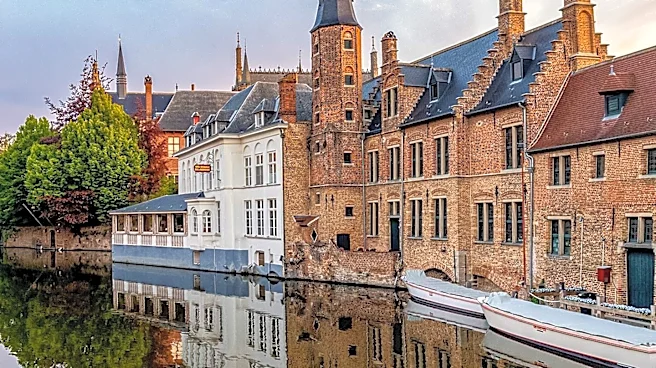









Bruges, located in the Flemish Region of Belgium, rose to prominence during the Middle Ages as a pivotal center for trade and finance. Its strategic location at the intersection of northern Hanseatic League trade routes and southern European commerce, combined with crucial geographical advantages and innovative economic practices, allowed it to become one of the world's chief commercial cities. This period, spanning from the 12th to the 15th centuries,
marked Bruges' golden age, characterized by significant wealth, urban development, and a cosmopolitan atmosphere that attracted merchants from across Europe.
The Golden Inlet and Early Trade Development
Bruges' commercial success was intrinsically linked to its access to the sea. In 1089, it became the capital of the County of Flanders, and by 1128, it had received its city charter, leading to the construction of new walls and canals. A critical natural event in 1134, a storm, re-established the city's direct access to the sea through the creation of a natural channel at Het Zwin, often referred to as the "Golden Inlet." This new sea arm extended to Damme, which quickly became Bruges' commercial outpost. This access was vital, as gradual silting had previously threatened to cut off the city from maritime trade since about 1050.
With renewed sea access, Bruges quickly integrated into the circuit of Flemish and French cloth fairs by the early 13th century. When the traditional fair system began to decline, Bruges' entrepreneurs adapted by developing or adopting new forms of merchant capitalism, inspired by Italian practices. This involved multiple merchants sharing risks and profits, pooling their market knowledge, and utilizing advanced financial instruments like bills of exchange and letters of credit. The city actively welcomed foreign traders, including Portuguese merchants who brought valuable goods like pepper and other spices, further diversifying its commercial landscape.
Expanding Networks and Financial Sophistication
The city's economic reach expanded significantly through its connections with wool-producing regions in England and Scotland, which supplied the raw materials for its thriving wool market and weaving industry. English contacts also brought Normandy grain and Gascon wines to Bruges. The harbor, initially centered at Damme, had to be expanded to Sluys to accommodate larger cog-ships used by the Hanseatic League, which maintained a "kontor" or trading post in the city. This influx of goods and merchants solidified Bruges' position as a major international hub.
A pivotal moment occurred in 1277 with the arrival of the first merchant fleet from the Republic of Genoa. This marked the beginning of a merchant colony that transformed Bruges into the primary link for Mediterranean trade. This connection not only facilitated the trade of spices from the Levant but also introduced advanced commercial and financial techniques and a substantial flow of capital, which soon dominated Bruges' banking sector. The building that once housed Genoa's commercial representation in Bruges still stands today, now home to the Frietmuseum.
The Birth of the Stock Exchange and a Cosmopolitan Hub
Bruges' financial innovation culminated in the opening of the Bourse in 1309, widely considered the world's first stock exchange. This institution developed into the most sophisticated money market in the Low Countries during the 14th century. Even when Venetian galleys first arrived in 1314, they were considered latecomers to an already established financial center. The city welcomed numerous foreign merchants, including Castilian wool merchants who arrived in the 13th century. After the Castilian wool monopoly ended, Basque merchants, many from Bilbao, thrived by trading wool and iron commodities, establishing their own commercial consulate by the mid-15th century. These foreign merchant communities maintained separate governance under their own laws, contributing to Bruges' cosmopolitan character until an economic collapse after 1700.
This immense wealth, however, also led to social upheavals. In 1302, following the "Bruges Matins"—a night-time massacre of the French garrison by local Flemish militia—the population allied with the Count of Flanders against the French, leading to victory at the Battle of the Golden Spurs. The city maintained a permanent paramilitary militia, which gained prestige through its ties to organized guilds. By around 1350 AD, Bruges' population had grown to at least 46,000 inhabitants, with its weavers and spinners renowned as the best globally. In the 15th century, Philip the Good, Duke of Burgundy, established a court in Bruges, attracting artists, bankers, and prominent figures from across Europe, further cementing the city's status as a cultural and economic powerhouse.