




The 1963–64 season marked the 38th year for the Chicago Black Hawks in the National Hockey League, a period that saw the team build on previous successes while also facing new challenges. Coming off a strong 1962–63 season where they finished second and set club records for wins (32) and points (81), the Hawks were looking to make a deeper run after being defeated in the NHL semi-finals by the Detroit Red Wings. This previous loss had broken a streak,
as it was the first time since 1960 that Chicago did not reach the Stanley Cup finals. The new season brought changes, including a new head coach, and saw the team achieve new club records, engage in memorable on-ice battles, and ultimately experience a surprising playoff elimination.
Coaching Changes and a Strong Start
Before the 1963–64 season began, the Black Hawks made a significant change behind the bench. They decided not to retain head coach Rudy Pilous, opting instead to hire Billy Reay as his replacement. Reay was not new to NHL coaching, having previously served as head coach for the Toronto Maple Leafs from 1957 to 1959, where he compiled a record of 26 wins, 50 losses, and 14 ties. Most recently, Reay had been coaching the Buffalo Bisons in the American Hockey League (AHL), bringing fresh experience to Chicago.
Under Reay's leadership, the Black Hawks started the season with considerable momentum. They quickly established themselves as a formidable force, achieving an impressive 15–2–6 record in their first 23 games. This strong opening put them in contention for the top spot in the NHL standings, battling closely with perennial rivals like the Montreal Canadiens and the Toronto Maple Leafs. Despite a slight cooling off period after their initial hot streak, the Hawks maintained their competitive edge throughout the regular season.
On-Ice Drama and Record-Breaking Performances
The season was not without its dramatic moments, including a particularly wild game against the Toronto Maple Leafs on December 7. This contest escalated into a bench-clearing brawl after Toronto's Bobby Baun pulled Blackhawk Reg Fleming out of the penalty box, where Fleming was about to serve a penalty for spearing Toronto player Eddie Shack. The incident resulted in a flurry of penalties and fines, highlighting the intense rivalry between the teams. A total of seven major penalties, six misconducts, and three game misconducts were issued, along with $25 fines for 22 players who left the bench. Coaches Billy Reay and Punch Imlach were each fined $1000, while several players received additional fines ranging from $50 to $200 for their roles in the altercation.
Despite such heated moments, the Black Hawks continued to play exceptional hockey. They finished the regular season in second place for the second consecutive year, setting new club records with 36 wins and 84 points. They narrowly missed the top spot, finishing just one point behind the Montreal Canadiens. Offensively, the team was led by Stan Mikita, who had a career-defining season. Mikita led the entire league with 89 points, earning his first Art Ross Trophy. Remarkably, he also led the team with 146 penalty minutes, becoming the first player in NHL history to lead the league in both scoring and penalty minutes. Bobby Hull contributed significantly with a league-high 43 goals and finished just behind Mikita with 87 points. Kenny Wharram also had a standout year, scoring 39 goals and 71 points, and was recognized with the Lady Byng Trophy for sportsmanship and gentlemanly conduct combined with a high standard of playing ability. On defense, Pierre Pilote continued his stellar play, contributing 7 goals and 53 points, and earning his second consecutive Norris Trophy as the league's best defenseman. In goal, Glenn Hall was a workhorse, playing the majority of games, winning a club-record 34 games, posting a 2.30 Goals Against Average (GAA), and recording 7 shutouts.
Playoff Disappointment Against the Red Wings
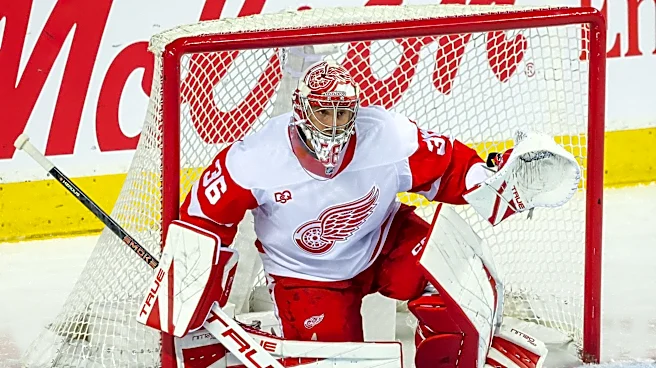
As the playoffs began, the Black Hawks were set to face the Detroit Red Wings in the NHL semi-finals. Detroit had finished fourth in the league with a record of 30 wins, 29 losses, and 11 ties, accumulating 71 points—13 fewer than Chicago. The series opened at Chicago Stadium, where the Black Hawks secured a 4–1 victory in Game 1. However, Detroit quickly evened the series with a 5–4 win in Game 2. The series then shifted to the Detroit Olympia, where the Red Wings took a 2–1 lead by shutting out Chicago 3–0 in Game 3. The Hawks responded in Game 4, winning 3–2 in overtime to tie the series once more.
Back in Chicago for Game 5, the Black Hawks held on for a 3–2 victory, taking a 3–2 series lead. Yet, the Red Wings proved resilient, hammering Chicago 7–2 in Game 6 back in Detroit, forcing a decisive Game 7. Despite having lost only five times at home all season, the Black Hawks were stunned in the final game. The underdog Red Wings defeated Chicago 4–2, eliminating the Black Hawks from the playoffs for the second consecutive season. This unexpected exit marked a disappointing end to a season that had seen the Black Hawks achieve numerous club records and individual accolades.