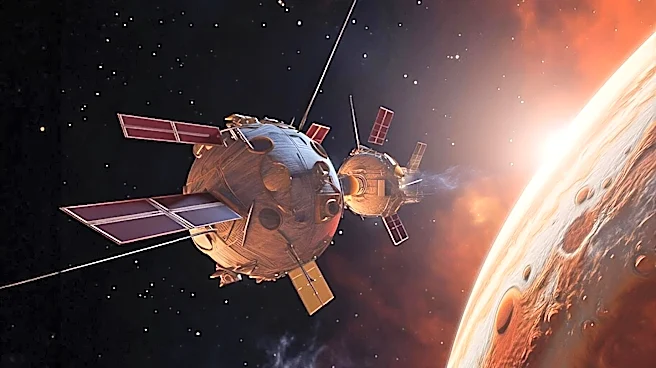

Mariner 1 was a groundbreaking mission for NASA, intended to be the first American planetary flyby of Venus. However, the mission faced significant technical challenges that ultimately led to its failure.
This article explores the technical issues encountered during the Mariner 1 mission, focusing on the guidance system errors and the subsequent impact on space exploration.
The Guidance System Error
The primary technical challenge that led to the failure of Mariner 1 was a guidance system error. The Burroughs guidance computer was responsible for issuing steering commands based on data transmitted from the Atlas's rate beacon. The guidance program was supposed to contain a character called an R-bar, which instructed the computer to ignore data from the rate beacon if it failed in-flight. Unfortunately, this character was accidentally left out of the program.
During the ascent, Mariner 1's booster briefly lost guidance-lock with the ground, a fairly common occurrence. The Atlas-Agena was designed to continue on a preprogrammed course until guidance-lock resumed. However, when lock was reestablished, the faulty guidance logic caused the program to erroneously report erratic velocity fluctuations, leading to actual erratic behavior. This forced the range safety officer to destroy the rocket.
The Impact of the Missing Symbol
The missing symbol in the guidance equations had catastrophic effects, highlighting the importance of software reliability. The error was a missing overline in "R-dot-bar sub n," which denotes a mean value. By its omission, an unsmoothed value was used, causing the control system to overreact to minor fluctuations. This error summed up the whole problem of software reliability and contributed to the development of software engineering.
The incorrect logic had been used successfully for Ranger launches, but the rate beacon had not malfunctioned on those missions, so the problem did not manifest. The Mod III-G guidance system used on Atlas-Agena vehicles was a persistent source of trouble, having malfunctioned on many launches since Atlas-Agena began flying in 1960. It was an adaptation of the Mod III guidance system used on Atlas B, C, and D missiles, with original vacuum tube electronics converted to transistors. However, the modification was done hastily and proved unreliable.
Lessons Learned and Future Implications
The failure of Mariner 1 underscored the importance of thorough pre-launch debugging of software and the need to engineer programs to prevent minor errors from causing catastrophic failures. The procedures implemented as a result of this incident served NASA well in future missions, including the Project Apollo Moon landings.
The incident also highlighted the need for improved fabrication of wiring harnesses and checkout procedures, which were implemented following the failure. The lessons learned from Mariner 1's failure contributed to the development of software engineering as a discipline, emphasizing the critical role of software reliability in space exploration.
Despite the failure, Mariner 1's sister spacecraft, Mariner 2, was successfully launched and became the first spacecraft to return data from the vicinity of Venus. The technical challenges faced during the Mariner 1 mission provided valuable insights that helped shape the future of space exploration.