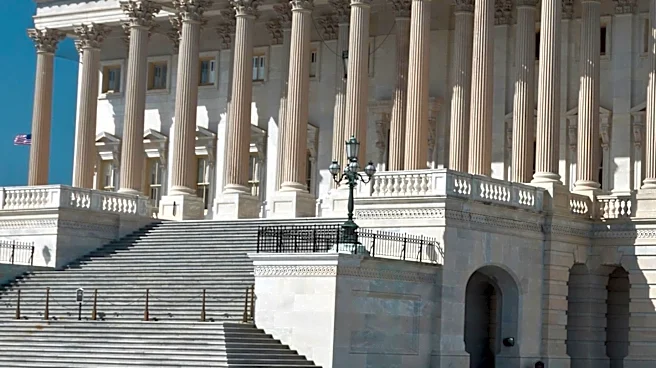





On November 7, 1983, the United States Capitol became the target of a bombing orchestrated by the Armed Resistance Unit, a militant leftist organization. This act of violence was explicitly carried out in response to recent U.S. military engagements in Grenada and Lebanon. The explosion, which occurred on the second floor of the Capitol's north wing, caused significant property damage, particularly within the Senate wing. While no structural damage to the Capitol was reported,
the incident left a lasting mark, leading to extensive repairs and becoming a key event in the broader Resistance Conspiracy case, one of the largest criminal trials in U.S. history.
The Attack on the Capitol
The bombing took place at 10:58 p.m., approximately two hours after the Senate had adjourned and a reception near the Senate Chamber had concluded. Minutes before the blast, a tape-recorded message was telephoned to both The Washington Post news desk and the Capitol switchboard. This message, claiming to be from the Armed Resistance Unit, warned of an imminent bomb detonation near the Senate Chamber, citing U.S. military involvement in Grenada and Lebanon as the motive. The explosive device was strategically placed beneath a bench at the eastern end of the corridor outside the Senate Chamber.The force of the explosion was considerable, blowing off the door to Democratic Leader Robert C. Byrd's office. Senator Byrd was known as an active supporter of U.S. involvement in Grenada and had recently sought to rally support for retaliation against attacks on U.S. Marines stationed in Lebanon. The blast also tore a hole in a wall partition, sending pulverized brick and plaster into the Republican cloakroom, shattering its glass windows. Major damage was inflicted upon arches, walls, and the glazed-tile floor near the point of detonation. A grandfather clock, which had stood by the Senate chamber since 1859, was destroyed. Additionally, six paintings were ripped, shredded, or damaged, including a portrait of Daniel Webster that sustained severe harm. Members of the Senate were able to recover fragments of the damaged painting, which a conservator then worked on for months to restore to a semblance of its original state. Officials estimated the total damages from the explosion at $1,000,000.
The Armed Resistance Unit and Its Broader Activities
The Armed Resistance Unit was a name used by the group Resistance Conspiracy, which was a U.S.-based branch of the larger communist organization known as the May 19th Communist Order. This organization was active from its first attack in 1976 until later incidents in 1985. Throughout its existence, the group was responsible for twenty incidents of politically motivated domestic terrorism, including one murder. The organization also operated under other names, such as the Red Guerilla Resistance and the Revolutionary Fighting Group. Beyond the Capitol bombing, the Armed Resistance Unit had also plotted to murder Henry Kissinger.Earlier in 1983, on April 25, a smaller bomb was detonated at the National War College at Fort McNair in Washington, D.C. A call to UPI before this attack mentioned "U.S. imperialism" as the motive. The National War College is a facility where American military officials receive high-level training. Following that explosion, the area was immediately sealed off. An Army colonel described the device as appearing to be "5 to 10 pounds of unknown explosives detonated by some sort of timing device," noting superficial damage to the building's exterior but no injuries. A year after the Senate bombing, on April 24, 1984, a group identifying itself as the Guerilla Resistance Movement claimed responsibility for a bombing at the Officer's Club at the Washington Navy Yard. This attack was motivated by opposition to U.S. policy in Central America and a call for Puerto Rican independence. The explosion, caused by a powerful bomb under a couch near the club's entrance, occurred at 1:50 AM, blowing out windows, collapsing part of a ceiling, and damaging the interior of the three-story brick building. Fortunately, the building was vacant, and no one was injured in that incident.