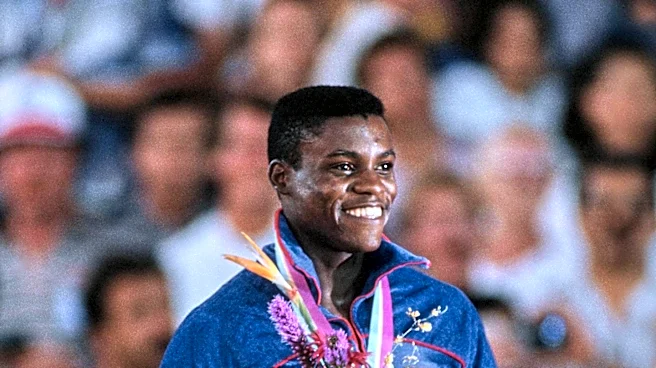



Frederick Carlton Lewis, born on July 1, 1961, in Birmingham, Alabama, would become one of the most celebrated American track and field athletes. His journey to athletic stardom was deeply rooted in his family's sporting background and the local athletics club run by his parents. This early environment provided a crucial foundation for both Carl and his sister, Carol, shaping their paths toward elite competition. From a young age, Lewis showed immense
promise, particularly in the long jump, an event that would define much of his illustrious career.
A Family Legacy in Athletics
Carl Lewis's athletic inclinations were clearly influenced by his family. His mother, Evelyn Lawler Lewis, was a hurdler who competed on the 1951 Pan-Am team, demonstrating an early connection to high-level sports. His elder brother, Cleveland Lewis, also pursued professional athletics, playing soccer for the Memphis Rogues. However, it was the local athletics club, managed by his parents, William and Evelyn Lewis, that served as a direct training ground and source of inspiration for Carl and Carol. This familial involvement in sports created an atmosphere where athletic excellence was not just encouraged but actively cultivated.
His father initially coached Carl, guiding him and other local athletes to elite status. This hands-on coaching from a parent figure likely instilled discipline and a strong work ethic from an early age. The family's dedication to track and field provided Carl with consistent support and expert guidance, which proved invaluable as he began to develop his skills. The influence of his parents' club extended beyond just Carl, as his sister Carol also became an elite long jumper, achieving significant success by finishing ninth at the 1984 Olympics and earning a bronze medal at the 1983 World Championships.
High School Talent and Breakthrough Performances
Carl Lewis began competing in the long jump at the age of 13, quickly emerging as a promising talent. During his time at Willingboro High School in Willingboro Township, New Jersey, he was coached by Andy Dudek and Paul Minore. Under their tutelage, Lewis's abilities blossomed, leading him to achieve the ranking of fourth on the all-time World Junior list of long jumpers. This early success hinted at the remarkable career that lay ahead, showcasing his natural aptitude for the event.
The year 1981 marked a significant breakthrough for Lewis. His personal best in the long jump, which had been his high school record from 1979, improved dramatically. On June 20, he leaped 8.62 meters (28 ft 3+1⁄4 in) at the TAC Championships, a remarkable achievement for a teenager. This period also saw him become the fastest 100-meter sprinter in the world. His 1979 best of 10.67 seconds improved to a world-class 10.21 seconds the following year. By May 16, 1981, he ran 10.00 seconds at the Southwest Conference Championships in Dallas, a time that was the third-fastest in history and stood as the low-altitude record. For the first time, Lewis was ranked number one in the world in both the 100 meters and the long jump, winning his first national titles in these events and receiving the James E. Sullivan Award as the top amateur athlete in the United States.
Dominance and the Pursuit of Records
Lewis continued his dominance into 1982, where he began to seriously challenge Bob Beamon's long-standing world record of 8.90 meters (29 ft 2+1⁄4 in) set at the 1968 Olympics. Before Lewis, only Beamon and Lutz Dombrowski had exceeded 8.53 meters (28 ft 0 in). In 1982, Lewis cleared 8.53 meters five times outdoors and twice more indoors, reaching an impressive 8.76 meters (28 ft 8+3⁄4 in) in Indianapolis on July 24. He also matched his low-altitude 100-meter record of 10.00 seconds that year. His performances in Indianapolis were particularly notable, with several fouls that observers believed exceeded Beamon's record, including one that some claimed reached 9.14 meters (30 ft 0 in). Lewis maintained his number one ranking in the 100 meters and long jump and was named Athlete of the Year by Track and Field News, solidifying his status as a rising star in the sport.