




The Atlanta Motor Speedway, located in Hampton, Georgia, approximately 30 kilometers south of Atlanta, has a rich history marked by significant transformations and a consistent reputation for speed. Inaugurated in 1960, the track began as a 1.5-mile, two-turn oval. Over the decades, it has evolved, undergoing a major remodel in 1997 that fundamentally altered its layout and solidified its status as one of NASCAR's fastest tracks. This evolution reflects
a continuous effort to adapt and enhance the racing experience for both competitors and spectators.
Early Years and Initial Design
When it first opened its gates in 1960, the Atlanta Motor Speedway was known as the Atlanta International Raceway. Its initial design featured a 1.5-mile oval with two distinct turns. This configuration served as the venue for NASCAR Cup Series races from its inception, quickly establishing itself on the racing calendar. The track's early years saw it host two Cup Series races annually, a tradition that continued for many decades. The spring race, typically 500 miles long, was a staple from the very first edition, while a second 500-mile race was added in 1967, often serving as the championship's final event from 1987 to 2000.
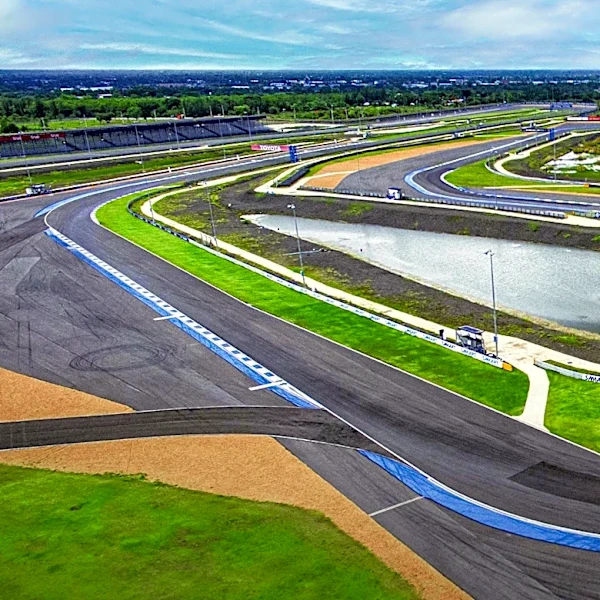
Beyond the main oval, the facilities also included a 4-kilometer mixed track and a quarter-mile flat oval situated between the main straight and pit lane. These additional layouts provided versatility for various racing disciplines, though the primary focus remained on the high-speed oval. The track's ownership changed hands in 1990 when businessman Bruton Smith acquired the circuit, integrating it into his company, Speedway Motorsports, by 1995. This acquisition marked a pivotal moment, setting the stage for future developments and modernizations.
The 1997 Remodel and Quad-Oval Configuration
Perhaps the most significant transformation in the track's history occurred in 1997 with a complete remodel. This extensive overhaul was designed to bring the Speedway in line with the standards of other 1.5-mile ovals owned by Speedway Motorsports. The remodel involved a dramatic change: the start-finish line and pit lane were swapped with the backstretch. Crucially, the main straight was redesigned to incorporate two bends, effectively changing the layout from a simple oval to a quad-oval. This modification also resulted in a slight increase in the track's length, from 1.5 miles to 1.54 miles (2.48 kilometers).
The 1997 remodel had a profound impact on the track's characteristics. The high banking of the turns, at 24 degrees, made the Atlanta oval historically one of the fastest on the NASCAR Cup Series calendar. Following the remodel, and particularly after restrictor plates were mandated for cars at Daytona and Talladega, Atlanta emerged as the track with the highest average speed on the calendar. This reputation for extreme speed became a defining characteristic, leading to the advertising slogan, "Real Racing. Real Fast." The track's ability to maintain high average speeds, often around 193 mph (approximately 311 km/h), with lap records exceeding 197 mph (approximately 317 km/h), cemented its place as a premier high-speed venue in NASCAR.
Modern Era and Event Evolution
In the years following the remodel, Atlanta Motor Speedway continued to host major NASCAR events. While it traditionally held two Cup Series races per year until 2010, it transitioned to a single visit annually starting in 2011. The NASCAR Xfinity Series has accompanied the Cup Series at Atlanta since 1992, initially during the spring race and then shifting to the fall race from 2002. The NASCAR Truck Series also became a regular visitor, starting in 2004 and even having a second date between 2005 and 2008. The track has also hosted other significant racing series, including CART in the late 1970s and early 1980s, and the IndyCar Series from 1998 to 2001. The IMSA GT Championship also ran a mixed track event there once in 1993. The installation of lighting for night races, initially for the Indy Racing League events between 1998 and 2001, further enhanced the track's capabilities, allowing for evening qualifying sessions and, eventually, night finishes for major races, adding another dimension to its storied history.