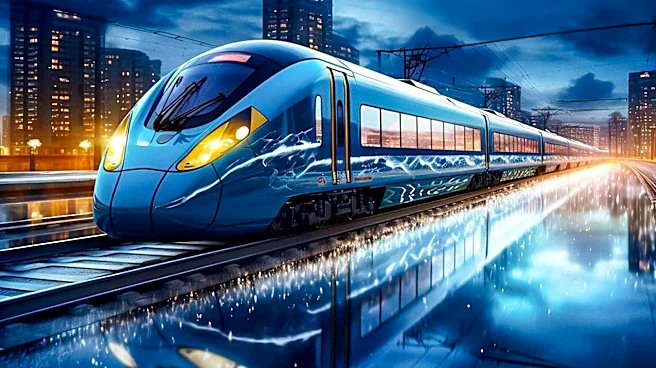









The Acela Express, a prominent feature of rail travel in the Northeast Corridor, has undergone significant evolution since its inception. Originally designed to offer high-speed service, the trainsets have seen continuous development, culminating in the introduction of the Avelia Liberty, marketed as the NextGen Acela. This progression highlights Amtrak's commitment to enhancing passenger capacity, speed, and overall efficiency on one of the nation's
busiest rail routes.
The First Generation Acela Express Trainset
The initial Acela Express trainset was composed of two power cars, a Café car, a First Class car, and four Business Class cars, all semi-permanently coupled. This configuration provided a specific seating arrangement, with the First Class car offering 44 seats, arranged as three seats across (one on one side, two on the other), and including four-seat tables and assigned seating. The Business Class cars collectively provided 260 seats, with a four-seat across arrangement (two on each side), also featuring four-seat tables and assigned seating. These trains were designed to be wheelchair-accessible, with each car equipped with one or two toilets, one of which was ADA compliant. Baggage could be stored in overhead compartments or under seats.
While designed for a top speed of 165 mph (266 km/h), the first-generation Acela's actual operating speeds were often limited by the existing infrastructure of the Northeast Corridor. The trainsets utilized a tilt system that allowed for leaning up to 4.2 degrees, which helped navigate curves at higher speeds. However, the design also incorporated heavier conventional structures to satisfy FRA crashworthiness requirements, contributing to the overall weight of the train. Despite these limitations, the first-generation Acela played a crucial role in establishing high-speed rail service in the U.S.
Introducing the Avelia Liberty: The NextGen Acela
Starting in 2025, the original Acela Express equipment began to be replaced by the new Avelia Liberty trainsets, which Amtrak markets as the NextGen Acela. These second-generation trains represent a significant leap forward in design and technology. The Avelia Liberty is part of Alstom's Avelia family of high-speed trains, specifically developed for the North American market. Its passenger cars draw inspiration from the AGV used in Italy, while the concentrated power cars share design elements with the Avelia Horizon, developed for the French TGV network. The tilt system is adapted from the Pendolino, showcasing a blend of international high-speed rail innovations.
A key difference in the Avelia Liberty's design is its articulation. Unlike the original Acela, where cars rode on their own bogies and were semi-permanently coupled, the Avelia Liberty is articulated. This means the wheel-and-axle frames are positioned beneath the gangways between adjacent cars, forming a single connected trainset. This articulation helps reduce noise and vibration by moving the bogies away from the seating areas. The new trains also feature Alstom's crash-energy-management system, a lighter approach to meeting FRA crashworthiness requirements compared to the heavier structures of the first generation.
Enhanced Capacity and Performance
Each Avelia Liberty trainset is formed of two short-wheelbase power cars that bracket nine articulated passenger cars. The design also allows for the insertion of three additional cars if passenger demand increases. This configuration provides a greater passenger capacity, with each set carrying 386 passengers—378 seats plus eight wheelchair spaces—which is roughly 25% more than the 304-seat first-generation set. This increased capacity is vital for accommodating the growing number of travelers on the Northeast Corridor.
The Avelia Liberty also boasts an enhanced active tilt system, known as Tiltronix, which allows the cars to lean by up to 6.3 degrees. This is a significant improvement over the 4.2 degrees of the first generation, enabling roughly 30% higher speeds through curves. The two power cars deliver a combined output of about 7,000 kW (9,400 hp). While designed for a top speed of 220 mph (350 km/h) with tilt disabled and 186 mph (299 km/h) in tilting service, the trains are currently limited to 160 mph (260 km/h) due to the existing Northeast Corridor track and signaling infrastructure. Alstom describes the Avelia Liberty as lighter and more energy-efficient, incorporating regenerative braking for energy recovery, further contributing to its advanced design.
Operational Rollout and Future Impact
The first five Avelia Liberty trainsets entered passenger service on August 28, 2025. As of July 2026, 13 of the total order of 28 trainsets have entered service, marking a steady transition to the new fleet. This phased rollout ensures a smooth integration of the NextGen Acela into Amtrak's operations. The enhanced features of the Avelia Liberty, including greater passenger capacity and improved speed capabilities, are expected to significantly impact travel efficiency and comfort on the Northeast Corridor. The modernization of the Acela fleet underscores Amtrak's ongoing efforts to provide a state-of-the-art rail experience for its passengers, adapting to evolving demands and technological advancements in high-speed rail.
These new trains are poised to redefine the Acela service, offering a more modern, efficient, and comfortable journey for travelers. The transition from the first-generation Acela Express to the Avelia Liberty represents a pivotal moment in the history of U.S. high-speed rail, demonstrating a commitment to innovation and improved service quality.