


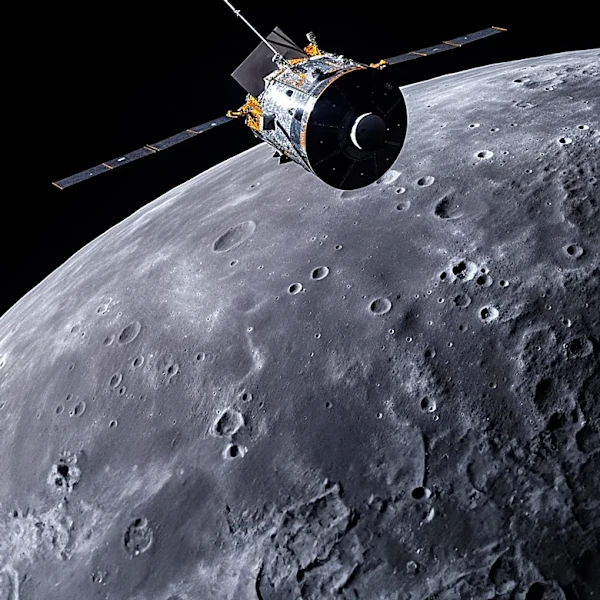





Gemini 5 was a crucial mission in NASA's Project Gemini, designed not only to test human endurance in space but also to develop the sophisticated orbital mechanics necessary for future lunar missions. The ability to rendezvous and dock spacecraft in orbit was paramount for the Apollo program, which envisioned transferring astronauts to a lunar lander. Gemini 5's objectives included pioneering rendezvous maneuvers with a target satellite, a complex
task that had never been fully achieved by the United States. Despite facing significant in-flight challenges, the mission made groundbreaking strides in precision orbital navigation, laying essential groundwork for the journey to the Moon.
The Initial Rendezvous Plan and Early Setbacks
One of the primary goals for Gemini 5 was to perform rendezvous maneuvers with a target satellite, specifically a "pod" that the Gemini spacecraft itself would deploy. This was a critical step in proving the techniques required for future space operations, including docking. The mission plan called for Cooper and Conrad to eject the Rendezvous Evaluation Pod (REP) early in the flight and then maneuver their spacecraft to meet it. This would have been a direct test of their ability to locate, track, and approach another object in orbit, a skill vital for lunar orbit rendezvous.
However, this ambitious plan encountered an immediate and significant setback. Just over four hours into the flight, after the REP had been ejected, a critical pressure drop occurred in one of the fuel cells. This forced the astronauts to shut down the fuel cells, leaving them reliant on battery power. With the fuel cells off, the power limitations made the planned rendezvous with the REP impossible. For a time, the mission's continuation was in doubt, and even a premature abort was considered. This incident highlighted the fragility of early space systems and the constant need for adaptability and quick problem-solving by both the crew and ground control.
The Phantom Rendezvous: A Triumph of Orbital Mechanics
Despite the failure of the initial rendezvous plan due to the fuel cell issue, the mission's objectives for orbital maneuvering were not abandoned. With the fuel cells eventually stabilized and reactivated, an alternative approach was devised. Buzz Aldrin, who held a doctorate in orbital mechanics, played a key role in working out a scheme for a "phantom rendezvous." This innovative plan involved the crew maneuvering the Gemini spacecraft to a given, predetermined point in space, effectively simulating a rendezvous without a physical target vehicle.
This phantom rendezvous, conducted on the third day of the mission, was a resounding success and a significant breakthrough. It marked the first precision maneuver ever performed on a spaceflight. Cooper and Conrad executed four distinct maneuvers using the Orbit Attitude and Maneuvering System (OAMS): an apogee adjust, a phase adjust, a plane change, and a coelliptical maneuver. These precise orbital adjustments demonstrated the capability of the Gemini spacecraft and its crew to accurately control their trajectory and position in space. This success was crucial, proving that the fundamental techniques for orbital rendezvous were viable, even if the initial target pod could not be used.
Navigation Challenges and Reentry Accuracy
Beyond rendezvous, Gemini 5 also contributed to understanding and refining navigation for reentry. The mission's conclusion involved the astronauts controlling the reentry process, creating drag and lift by rotating the capsule. However, the landing point was significantly off target, with the crew splashing down 80 miles short of the planned location in the Atlantic Ocean. This inaccuracy was traced to a computing error: a programmer had incorrectly entered the Earth's rotation rate as 360 degrees per 24 hours instead of the more precise 360.98 degrees.
This incident, while resulting in an off-target landing, provided valuable lessons in the precision required for orbital mechanics and computer programming in spaceflight. It underscored the importance of even minute details in calculations for missions that spanned multiple days and orbits. Despite the landing deviation, the recovery operation was robust, involving a large contingent of U.S. Department of Defense resources, including personnel, aircraft, and ships, ensuring the safe retrieval of Cooper and Conrad. The lessons learned from both the successful phantom rendezvous and the reentry error were instrumental in refining the navigation and control systems for subsequent Gemini missions and ultimately for the Apollo program's journey to the Moon.