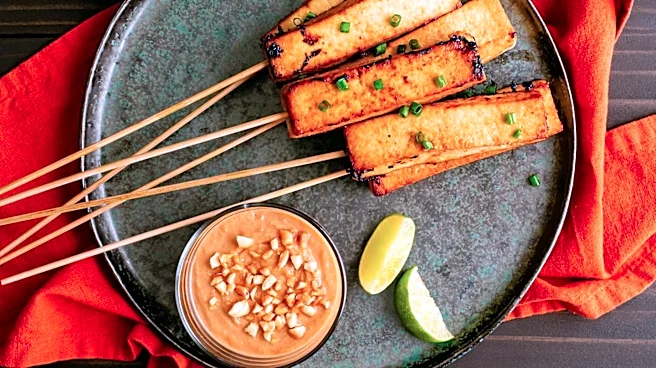










Satay, a dish of seasoned, skewered, and grilled meat served with a sauce, is a culinary staple deeply rooted in Maritime Southeast Asia. While often associated with Indonesia, Malaysia, Singapore, Brunei, and Thailand, its journey extends far beyond these borders, reflecting a rich history of cultural exchange and adaptation. From its origins influenced by Middle Eastern and South Asian culinary traditions to its widespread popularity as street food
and national dishes, satay has evolved into numerous regional variations, each bearing the unique stamp of local ingredients and cooking customs.
The dish's global recognition grew significantly from the mid-20th century onwards, as migration and diaspora communities introduced it to new parts of the world. Indonesian, Malaysian, Singaporean, and Thai emigrants established restaurants across Asia, Europe, Australia, and North America, further cementing satay's status as a signature Southeast Asian dish. International food festivals, cookbooks, and diplomatic events have also played a crucial role in promoting its widespread appeal.
Origins and Early Influences
Satay's evolution is a fascinating blend of foreign and local culinary influences. The introduction of Middle Eastern kebabs by Muslim traders, South Asian cooking techniques brought by Tamil and Gujarati merchants, and Chinese practices like bamboo skewering and preparing bite-sized portions all contributed to its development. These influences were adapted in the bustling port cities of Java, Sumatra, and the Malay Peninsula, where they merged with regional ingredients and spices such as lemongrass, turmeric, galangal, and peanuts. This fusion gave rise to a distinctly Southeast Asian style of grilled skewered meat.
Some historical accounts suggest that the dish, or its precursor, may have existed as early as the 8th to 10th century, with a satay relief found at the ancient Cabean Kunti bathing site in Central Java. The Indonesian publication Koran Jakarta even claimed that "sate," and ultimately satay, originated from the Javanese term "sak beteng," meaning "one stick," suggesting a deep historical root within the region. The influx of Indian and Arab traders starting in the 18th century also coincided with the introduction of satay and other iconic dishes based on meats like goat and lamb.
Colonial Era Expansion and Adaptation
During the colonial era, satay began its journey beyond Maritime Southeast Asia through various channels, including indentured labor recruitment, penal and military transfers, merchant networks, and later, the migration of colonial administrators and their families. This movement, spanning from the late 18th century through the first half of the 20th century, carried both people and culinary practices to new social and ecological settings. Dutch and British observers documented satay as a popular food across the Indonesian archipelago and the Malay Peninsula by the 19th century, noting street vendors selling skewered meats grilled over portable charcoal braziers.
This period saw satay becoming embedded in the culinary life of multi-ethnic port cities. In Singapore, it was widely sold by hawkers and became a popular evening street food, eventually concentrating in venues like the Satay Club. In Malaysia, towns such as Kajang emerged as centers of satay production and consumption. The dish also traveled to the Netherlands, where returning colonial officials, Indo-Dutch families, and post-war migrants integrated it into domestic cooking and restaurant traditions. In the Netherlands, "sate" became a central feature of the "rijsttafel" and remains a popular staple of Dutch cuisine, often served with spicy peanut sauce and available in snack bars and supermarkets.
Global Reach and Modern Interpretations
Satay's global reach is evident in its adaptations in various countries. In South Africa, Malay settlers at the Cape developed "sosatie," a marinated and skewered meat dish influenced by satay, which became a distinctive part of Cape Malay and broader South African cooking. Unlike Southeast Asian satay, sosaties are typically marinated overnight in a mixture that may include onions, chilies, garlic, curry leaves, and tamarind juice, and are often interspersed with ingredients like dried apricots, peppers, or onions, giving them a unique sweet-savory profile.
Similarly, Javanese laborers introduced satay to Suriname, where it became a hallmark of Javanese-Surinamese cuisine and later integrated into the broader national food culture. In Sri Lanka, Malay communities who arrived through colonial-era transfers preserved the dish within their own culinary traditions, where it is known as satay and served at communal and festive occasions. These diverse adaptations highlight satay's enduring appeal and its capacity to transform while retaining its core identity as a grilled, skewered delicacy.