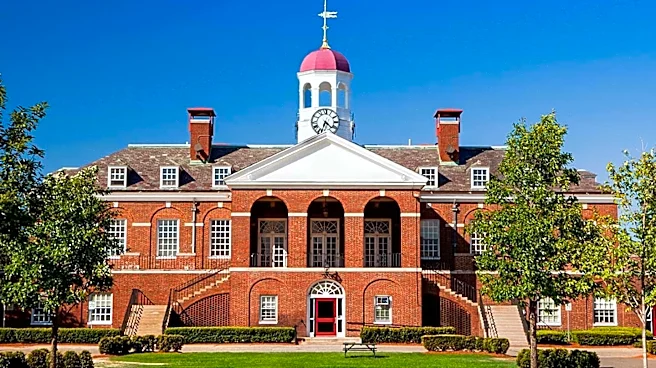







The Department of History at Harvard University stands as one of the oldest and most distinguished academic departments dedicated to historical studies in the United States. Located within the Faculty of Arts and Sciences in Cambridge, Massachusetts, its roots stretch back to the very early days of Harvard College. As early as 1643, just a few years after the college's founding, students were required to dedicate one hour per week to the study of history.
This early emphasis on historical inquiry laid the groundwork for what would become a globally recognized center for historical scholarship. The department's long-standing commitment to the discipline has shaped not only its own trajectory but also the broader field of historical study.
Pioneering Professionalization and Notable Scholars
By the late 1800s, Harvard's History Department played a crucial role in the professionalization of historical study at the graduate level. A significant milestone occurred in 1873 when the department awarded its first Doctor of Philosophy in history, setting a precedent for advanced historical research and training. This period also saw the achievement of W.E.B. Du Bois, who earned his Ph.D. in history from the department in 1895, becoming the first African American to receive a doctorate from Harvard. Du Bois later taught at Harvard until 1924, profoundly influencing the study of American history. Today, the department continues to be home to many of the world's leading and most renowned scholars in history, maintaining its reputation for academic excellence and groundbreaking research.
Addressing the Legacy of Slavery
In 2006, Harvard University launched the "Harvard and Slavery" initiative, a significant effort to research and acknowledge the historical connections between the university and slavery. This program began with "Harvard and Slavery: Seeking a Forgotten History," which compiled undergraduate research linking the institution's history to local slavery. The findings, published in a 2011 report, revealed that Harvard benefited from donations tied to a slave-based economy, was associated with scholars who promoted ideas of scientific racism, and employed professors and students who owned enslaved people. This initiative aimed to inspire deeper investigation and broader discussion about the contemporary implications of this history.
Further steps were taken to confront this legacy. In 2016, then-Harvard University President Drew Gilpin Faust and Congressman John Lewis unveiled a plaque dedicated to the memory of four enslaved individuals—Titus, Venus, Bilhah, and Juba—who worked at the university. This ceremony was widely regarded by scholars as an important step in recognizing the historical impact of slavery. In 2017, a memorial was erected at Harvard Law School to honor "the enslaved whose labor created wealth that made possible the founding of the Harvard Law School." The subsequent University President, Lawrence S. Bacow, announced a $5 million investment to continue investigating Harvard's ties to slavery, led by Radcliffe Institute for Advanced Study Dean Tomiko Brown-Nagin. While efforts to connect with descendants faced challenges, including the laying off of the Harvard Slavery Remembrance Program staff in January 2025, university officials stated that these efforts would continue through a third party. The department's commitment to confronting its past underscores its role in shaping contemporary historical discourse.
Global Recognition and Rankings
The Department of History at Harvard is consistently cited as one of the premier institutions globally for the study of history. Its academic standing is reflected in various rankings. U.S. News & World Report ranks the department at number four. Furthermore, according to the QS World University rankings in history, Harvard has consistently held the top position among history faculties worldwide from 2020 to 2023. This sustained recognition highlights the department's ongoing influence, the caliber of its faculty, and its significant contributions to historical scholarship on a global scale.