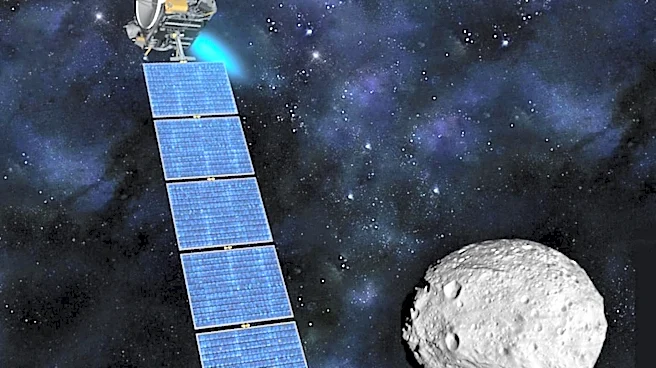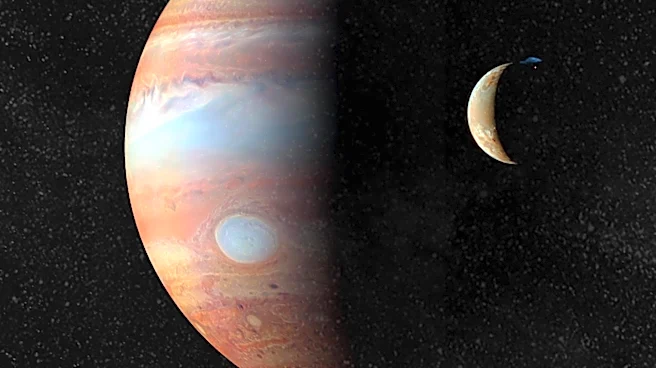





The Galileo mission, an American unmanned NASA endeavor, was designed to unlock the mysteries of Jupiter and its extensive system of moons. Launched on October 18, 1989, and arriving at Jupiter on December 7, 1995, Galileo comprised an orbiter and an atmospheric entry probe. Despite facing significant technical challenges, including a crippled high-gain antenna, the spacecraft delivered a wealth of unprecedented scientific data, fundamentally changing
our understanding of the Jovian system. Its discoveries ranged from the unexpected composition of Jupiter's atmosphere to the potential for subsurface oceans on its icy moons, leaving a profound and lasting legacy in planetary science.
Probing Jupiter's Turbulent Atmosphere
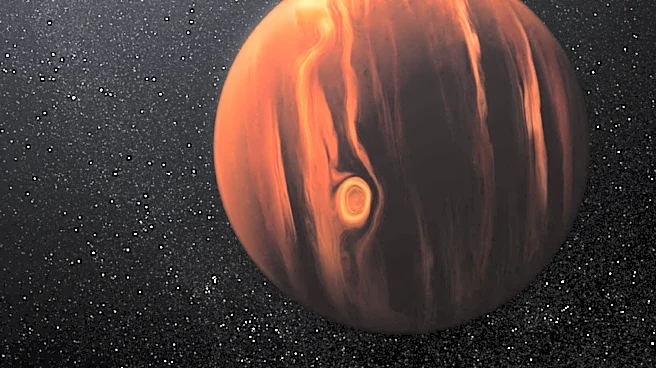
One of Galileo's primary objectives was to directly sample Jupiter's atmosphere. The atmospheric probe, which separated from the orbiter five months before arrival, plunged into Jupiter's atmosphere on December 7, 1995. It entered at an astonishing speed of 170,700 kilometers per hour, enduring a peak deceleration of 228 g0 and temperatures of about 14,000 °C, which caused its carbon phenolic heat shield to lose over half its mass. The probe transmitted data for 61.4 minutes, reaching a depth of 180 kilometers below the cloud tops before succumbing to the extreme pressure and temperature.
The data from the probe revealed a Jupiter far more complex than anticipated. Scientists had predicted three distinct cloud layers, but only one significant layer was measured, along with indications of smaller areas of increased particle densities. The atmosphere was found to be much denser and hotter than expected. Wind speeds were also surprisingly high, reaching up to 530 kilometers per hour, suggesting that Jupiter's powerful winds are driven by an internal heat source rather than sunlight or water vapor condensation. The probe detected less lightning and less water than expected, but a higher abundance of noble gases like argon, krypton, and xenon. This high noble gas abundance suggested that Jupiter might have formed in a much colder environment, around -240 °C, or that the interstellar debris from which the Solar System formed was colder than previously thought. The abundance of nitrogen, carbon, and sulfur was three times that of the Sun, hinting at their acquisition from other Solar System bodies.
Exploring the Galilean Moons: Io, Europa, Ganymede, and Callisto
Galileo's orbiter conducted numerous close flybys of Jupiter's four largest moons, known as the Galilean moons, each revealing unique characteristics. Io, the innermost, proved to be the most volcanically active body in the Solar System. Galileo observed dramatic changes on its surface between orbits, with infrared imaging showing lava flows over 60 kilometers long. Despite challenges with the tape recorder and high radiation levels, Doppler data from Io flybys revealed a molten iron and iron sulfide core. Later extended missions allowed for more detailed observations, including the capture of erupting volcanoes and the discovery that Io lacks an intrinsic magnetic field, indicating its core does not have Earth-like convective properties.
Europa, the smallest Galilean moon, captured significant attention due to evidence suggesting a subsurface ocean. Galileo's images showed a surface covered in cracks and very few impact craters, implying an active geology that renews the surface, estimated to be only 30 to 70 million years old. NIMS observations indicated magnesium- and sodium-based salts on the surface, likely from a brine layer beneath the ice. Further evidence came from the magnetometer, which detected an induced magnetic field, consistent with a conductive layer like saltwater. This hinted at the possibility of liquid water sustained by tidal flexing, despite the extremely cold surface temperatures. Galileo also provided evidence of crustal slippage over time, suggesting plate tectonics on Europa.
Ganymede, the largest moon in the Solar System, presented another groundbreaking discovery: it possesses its own magnetic field, strong enough to create a separate magnetosphere within Jupiter's. This was the first time a moon within a host planet's magnetosphere was found to have its own magnetic field. This discovery pointed to an iron or iron sulfide core and mantle encased in ice, with a possible subsurface brine ocean. Images of Ganymede's surface revealed two types of terrain: highly cratered dark regions and grooved terrain. Scientists speculated that radioactivity or volcanism might provide enough heat for liquid water to exist 50 to 200 kilometers below the surface.
Callisto, the outermost Galilean moon, is the most heavily cratered body in the Solar System, suggesting an ancient surface, possibly up to four billion years old. However, close-up observations revealed a puzzling absence of small craters and signs of erosion, indicating active geological processes. Initial data suggested a homogeneous composition, but later radio Doppler observations indicated a differentiated internal structure with rock settled towards the core. Like Europa and Ganymede, Callisto's induced magnetic field suggested the presence of a subsurface brine ocean, as ice alone would not be conductive enough to generate this effect. Galileo's flybys of Callisto were also instrumental in slingshot maneuvers to set up encounters with other moons, demonstrating its dual role in scientific discovery and mission navigation.