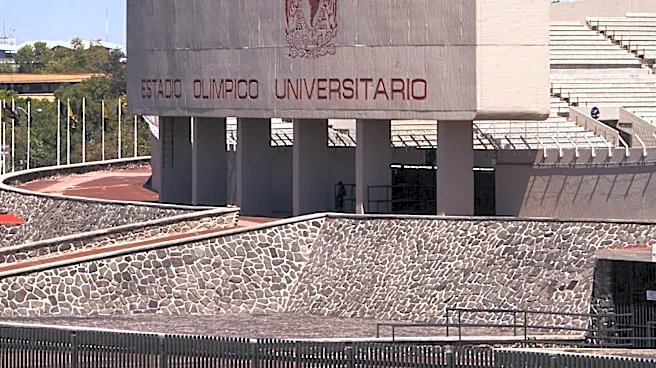



The Men's 400 meters at the 1968 Summer Olympics in Mexico City was a landmark event, particularly for its record-shattering performances and the overwhelming strength of the United States team. Held from October 16 to 18 at the University Olympic Stadium, this competition saw athletes push the boundaries of speed, culminating in a new world record. The event drew 55 competitors from 36 nations, making it a truly international spectacle, but it was the American
contingent that ultimately left an indelible mark on Olympic history.
A Field of Champions and Newcomers
The 1968 Men's 400 meters marked the sixteenth appearance of this event at the Summer Olympics, a testament to its enduring presence as one of the core athletics disciplines. Among the competitors, Andrzej Badeński of Poland stood out as the sole finalist from the previous 1964 Tokyo Games to return, having earned a bronze medal then. This continuity provided a link to past Olympic contests, yet the field was also rich with new talent and nations making their debut in the event. Barbados, the Dominican Republic, El Salvador, Morocco, Nicaragua, and Sudan all had athletes competing in the Men's 400 meters for the first time. Additionally, the federation of Malaysia made its inaugural appearance, though Malaya had participated previously. The political landscape was also reflected in the competition, as East and West Germany competed separately for the first time, adding another layer of historical significance to the Games.
The Unprecedented American Dominance
The United States team arrived in Mexico City with an undeniable air of superiority in the 400 meters. Their roster was stacked with formidable talent, leading many to anticipate a dominant performance. Larry James held the world record at an impressive 44.1 seconds, setting a high bar for the competition. Lee Evans, another American powerhouse, was the reigning AAU and NCAA champion, demonstrating his consistent excellence at the highest levels of collegiate and amateur athletics. Even the third member of the U.S. team, Ron Freeman, had showcased exceptional speed, running well below the existing Olympic record time during the U.S. trials. This trio represented a formidable challenge to any competitor hoping for a medal, and their collective strength underscored the depth of American talent in this particular event. The United States, in fact, was the only nation to have competed in the Men's 400 meters at every Olympic Games up to that point, marking its sixteenth appearance.
A Cascade of Broken Records
The competition unfolded with a series of record-breaking runs, signaling that the high altitude of Mexico City, combined with elite athletic preparation, was conducive to fast times. Prior to the event, the world record stood at 44.1 seconds, set by Larry James just a month before the Olympics. The Olympic record was 44.9 seconds, established by Otis Davis in 1960. These marks, however, were destined to fall. In the second semifinal, Lee Evans broke the Olympic record with a time of 44.8 seconds. Remarkably, both Larry James and Martin Jellinghaus matched the old Olympic record in the very same semifinal heat, highlighting the intense level of competition. The final race proved to be even more extraordinary. All three American medalists surpassed the newly set Olympic record. Lee Evans ultimately claimed the gold medal with an astonishing 43.8 seconds, while Larry James secured silver with 43.9 seconds. Both of these times were not only under the new Olympic record but also surpassed the existing world record. Evans' auto-timed result of 43.86 seconds, though not officially recognized by the rules at the time which favored hand-timed results, was later acknowledged as the initial world record when automatic timing became official in 1977, solidifying his place in history.
The Competition Format: A Path to the Podium
The structure of the Men's 400 meters competition in 1968 largely followed the established four-round format that had been in place since 1920. The "fastest loser" system, which had been introduced in 1964 to ensure balanced quarterfinal heats, was available but ultimately not utilized in 1968. This was due to the efficient structure of the first round, which featured eight heats. Each of these initial heats contained between six and eight athletes, with the top four finishers automatically advancing to the next stage. Following this, four quarterfinals were held, each comprising eight runners. Again, the top four athletes from each quarterfinal heat progressed to the semifinals. The semifinals consisted of two heats, each with eight runners. From these, the top four competitors in each semifinal heat earned their spot in the final, creating an eight-man showdown for the Olympic medals. This systematic progression ensured that only the most consistent and fastest athletes reached the ultimate race for glory.