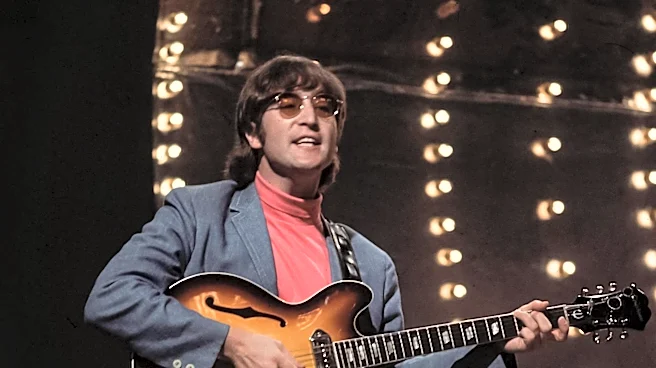




May Pang played a pivotal and multifaceted role during John Lennon's "Lost Weekend," an 18-month period from 1973 to 1975 when Lennon was separated from Yoko Ono. Initially Lennon and Ono's personal assistant and production coordinator, Pang became Lennon's companion during this time. Her influence extended beyond a personal relationship, encompassing significant professional contributions to his music and active efforts to mend his estranged family
ties. Pang's account of this period, later detailed in her memoirs, offers a unique perspective on a complex chapter in Lennon's life.
From Assistant to Companion: The Unconventional Beginning
May Fung Yee Pang, born in Manhattan in 1950, began her career in the music industry after attending New York City Community College. After working as a song plugger and a receptionist at ABKCO Records, she was asked to assist John Lennon and Yoko Ono with their avant-garde film projects in December 1970. This led to a permanent position as their personal assistant when the Lennons moved to Manhattan in 1971. Pang's responsibilities were extensive, including coordinating an art exhibition for Ono in Syracuse, New York, which coincided with Lennon's 31st birthday party.
The transition from assistant to companion occurred in mid-1973, amidst marital problems between Lennon and Ono. Ono herself initiated the idea, suggesting to Pang that she become Lennon's partner. Ono explained that she and Lennon were not getting along and were growing apart, and that Lennon found Pang sexually attractive. Despite Pang's initial reluctance, citing Lennon's married status and her employment, Ono insisted she would handle everything. This unconventional arrangement marked the beginning of Pang's 18-month relationship with Lennon, a period he later termed his "Lost Weekend."
Professional Contributions to Lennon's Music
During the "Lost Weekend," Pang's professional involvement in Lennon's career remained significant. In October 1973, she accompanied Lennon to Los Angeles to promote his *Mind Games* album. While there, Lennon was inspired to work on two new recording projects: an album of rock 'n' roll classics and producing another artist. In December 1973, Lennon collaborated with Phil Spector on the *Rock 'n' Roll* album. Despite the chaotic nature of these sessions, marked by Lennon's drinking and Spector's erratic behavior, Pang remained a constant presence.
In March 1974, Lennon began producing Harry Nilsson's *Pussy Cats* album. To ensure the musicians' punctuality and focus, Pang rented a beach house in Santa Monica where she, Lennon, Nilsson, Ringo Starr, and Keith Moon lived together. Her organizational skills were crucial in creating a conducive environment for recording. Upon their return to Manhattan in June 1974, Lennon stopped drinking and concentrated on his *Walls and Bridges* album. Pang's contributions were recognized with an RIAA gold record award for her work on *Walls and Bridges*. She continued as production coordinator for Lennon's *Rock 'n' Roll* album, where she was credited as "Mother Superior." Her voice can also be heard whispering Lennon's name on the track "#9 Dream," and the song "Surprise, Surprise (Sweet Bird of Paradox)" was written about her. Beyond Lennon's projects, Pang also worked on albums for Nilsson, Starr, Elton John, and David Bowie, showcasing her broad professional capabilities.
Fostering Reconnections and Family Bonds
One of Pang's most impactful roles during this period was her active encouragement of Lennon to reconnect with his estranged family and friends. This initiative led to several significant reconciliations. She facilitated a reunion between John and Paul McCartney, who played together for the first and only time after the Beatles' breakup. More personally, Pang arranged for Julian Lennon to visit his father, marking their first meeting in over two years. This visit proved transformative for their relationship.
Julian Lennon fondly recalled this time, stating, "Dad and I got on a great deal better then. We had a lot of fun, laughed a lot and had a great time in general when he was with May Pang. My memories of that time with Dad and May are very clear—they were the happiest time I can remember with them." John Lennon, encouraged by Pang, nurtured Julian's musical interests by gifting him a Gibson Les Paul copy guitar and a drum machine for Christmas in 1973, and teaching him chords. The cover of Julian's seventh album, *Jude*, features a childhood photograph taken by Pang, a testament to the positive impact she had on their father-son bond.
The Abrupt End and Lasting Legacy
The "Lost Weekend" came to an abrupt end in February 1975. While Lennon and Pang were making plans for their future, including an offer on a Scottish-style cottage in Montauk, New York, and a planned visit to Paul and Linda McCartney, Lennon reconciled with Yoko Ono. Ono claimed to have a new cure for Lennon's smoking habit, and after their meeting, Lennon did not return home or contact Pang. When Pang called, Ono informed her Lennon was unavailable due to exhaustion from a hypnotherapy session. Two days later, Lennon reappeared, appearing stupefied and confused, leading Pang to believe he had been brainwashed. Lennon then informed Pang their relationship was over. Despite a few discreet meetings in subsequent years, their relationship was never rekindled.
Pang later published two books about her experiences: a memoir titled *Loving John* (1983), which was later updated and renamed *John Lennon: The Lost Weekend*, and a book of photographs, *Instamatic Karma* (2008). A documentary about their relationship, *The Lost Weekend: A Love Story*, was produced in 2022. These works ensure that May Pang's significant personal and professional contributions during John Lennon's "Lost Weekend" remain a documented part of his history.