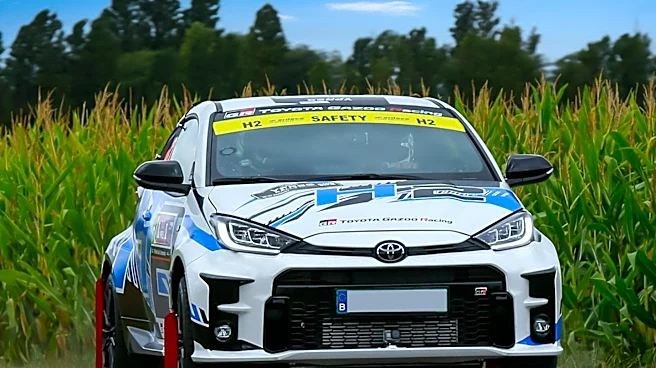







The Rally of Great Britain, known today as the Wales Rally of Great Britain, has played a crucial role in shaping the competitive landscape of modern rallying. From its inception in 1932 as the Royal Automobile Club (RAC) Rally, the event has continuously adapted its format, moving from simple regularity runs to complex, high-speed special stages. This evolution was not merely a change in rules but a fundamental shift in what defined a rally driver's
skill and a car's performance. The rally's journey reflects the broader transformation of motorsport, pushing boundaries and setting new standards for endurance, speed, and precision, ultimately influencing the global rally scene and its premier championship.
Early Days: Navigation and Regularity as the Core Challenge
In its earliest iterations, the RAC Rally presented a challenge quite different from the speed-focused events of today. The inaugural 1932 rally, and those that followed until World War II, emphasized navigation and adherence to strict time schedules. Competitors started from various cities across Great Britain and followed routes of approximately 1,000 miles, all converging at a single finish point. The official program highlighted the importance of checking in at controls within specific time windows and arriving at the final control as close to a fixed finishing time as possible, with deviations resulting in lost marks.Beyond maintaining schedules, participants also faced special exercises at the finish line. These included tests of slow driving, acceleration, and braking. For instance, Colonel A.H. Loughborough, recognized for having the fewest penalty points in the 1932 event, completed a 100-yard slow driving test at an average speed of 0.66 mph. This early format, while not focused on outright stage times, still demanded precision and vehicle control, laying a foundational understanding of competitive driving within a rally context. The absence of an official winner in the first few events underscored the focus on participation and completion rather than head-to-head speed.
The Post-War Shift: Introducing Speed and Technical Tests
After its post-war return in 1951, the RAC International Rally of Great Britain began to incorporate more direct tests of speed and vehicle capability. The itinerary expanded to 1,800 miles and included specific tests for speed, hill-climbing, and regularity. While still featuring multiple starting points, cars were brought together at Silverstone racing circuit for a high-speed test, followed by a common route through Scotland, Wales, and England. This marked a move towards more dynamic competitive elements, though the rally was still criticized in the mid-1950s for being "no more than a navigational treasure hunt" compared to more demanding European rallies.To address these criticisms and elevate the challenge, organizers introduced more complex tests. The 1953 event, part of the European Touring Championship, featured nine tests, including night driving at Castle Combe, a night climb of Prescott Hill, and a speed test at Goodwood. A new "garaging" test at Llandrindod Wells required drivers to maneuver into and out of a garage against the clock. These innovations aimed to demand greater driving skill and endurance, culminating in the decision to move the rally to November in 1959, hoping that wintry weather would transform it into a more rigorous driving test.
The Dawn of Special Stages: A Game-Changer for Rallying
The true transformation of the Rally of Great Britain, and by extension, modern rallying, came in the 1960s with the introduction of special stages. In 1960, organizing secretary Jack Kemsley secured permission from the Forestry Commission to use a closed two-mile gravel road, Monument Hill in Argyll, Scotland, as a speed test. This was a pivotal moment, as times from this stage were converted to points based on an average speed, signaling a departure from pure regularity.The impact was immediate and profound. As co-driver Stuart Turner noted, this was "the point at which the RAC Rally shifted from a traditional 'Find Your Way' on the public roads rally to the type of event we know today." The following year, 1961, saw extensive use of rough gravel forestry roads across the country as special stages, which quickly became the dominant factor in determining rally results. With the introduction of special timing clocks and seeded entries, the rally's future was secured, attracting international competitors and solidifying its reputation as one of the most grueling and unpredictable events on the calendar. By 1965, the rally boasted over 400 miles across 57 special stages, primarily in forests, cementing the format that would define World Rally Championship events for decades to come.