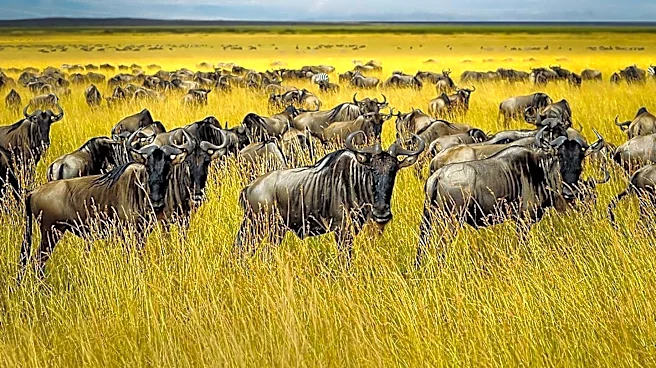



Each year, the Serengeti plays host to one of the most awe-inspiring natural phenomena on Earth: the great wildebeest migration. This circular journey, driven by the availability of grazing, begins in the Ngorongoro Conservation Area in the southern Serengeti of Tanzania. From there, the massive herds loop clockwise through the Serengeti National Park and continue north towards the Masai Mara reserve in Kenya. This epic movement involves millions
of animals, primarily wildebeest, but also hundreds of thousands of zebras and gazelles, making it a critical event for the ecosystem and a major draw for wildlife enthusiasts.
The Calving Season and Early Stages
The initial phase of the migration typically runs from about January to March, coinciding with the calving season. During this period, the southern Serengeti's short grass plains, enriched by recent rains, offer abundant grazing. This is a crucial time, as approximately 500,000 wildebeest calves are born within a concentrated two to three-week window in February. The presence of 260,000 zebras often precedes the 1.7 million wildebeest, followed by hundreds of thousands of other plains game, including around 470,000 gazelles. The timing of birth is vital; few calves born prematurely survive, largely because their small size makes them more vulnerable to predators when mixed with older calves from the previous year.
Movement Towards the Grumeti and Mara Rivers
As the rains conclude in May, the vast herds begin their movement northwest. They head towards the areas surrounding the Grumeti River, where they typically remain until late June. The river crossings, particularly those of the Grumeti and Mara rivers, are a highlight for safari-goers. These crossings, which begin in July, are fraught with danger as crocodiles lie in wait, ready to ambush the migrating animals. The spectacle of thousands of animals plunging into the water, often in a chaotic rush, is a powerful display of nature's raw intensity.
The Kenyan Leg and Return Journey
By late July or August, the herds arrive in Kenya, where they spend the remainder of the dry season. While the wildebeest and zebras make the full journey, Thomson's and Grant's gazelles typically move only east or west within the region. The journey is arduous, with approximately 250,000 wildebeest perishing during the 800-kilometer (500-mile) trek from Tanzania to the Maasai Mara National Reserve. These deaths are often due to thirst, hunger, exhaustion, or predation by large carnivores like big cats. In early November, with the onset of the short rains, the migration begins its southward return. The animals move back to the short grass plains of the southeast, usually arriving in December, just in time for the next calving season in February, completing the annual cycle.
The Role of Zebras and Herd Dynamics
Interestingly, zebras often initiate the river crossings, with wildebeest quickly following them into the water. During these crossings, herds can split into groups, and wildebeest are observed descending steep cliffs to reach the water. The sheer number of animals involved, with thousands making the crossing at once, underscores the scale of this natural event. The migration is a testament to the animals' instinctual drive to find sustenance, constantly moving to areas with fresh grazing, and is a cornerstone of the Serengeti's ecological identity.