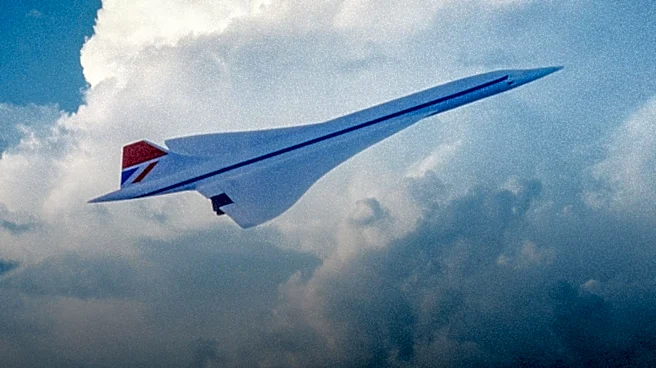









The Concorde, a marvel of supersonic engineering, began its scheduled commercial flights on January 21, 1976. Operated by both Air France and British Airways, these inaugural journeys marked a new era in air travel, connecting London to Bahrain and Paris to Rio de Janeiro via Dakar. However, the path to establishing a global network for the supersonic jet was far from smooth, encountering significant hurdles ranging from governmental bans and public
protests over noise to logistical challenges and economic viability concerns. The early years of Concorde's operation were a testament to both its groundbreaking capabilities and the complex environment it had to navigate.
Initial Launch and North American Hurdles
The very first scheduled flights saw British Airways using the distinctive "Speedbird Concorde" call sign to alert air traffic control to the aircraft's unique operational characteristics, while Air France maintained its standard call signs. Shortly after the initial routes, a Paris-Caracas service via the Azores commenced on April 10. However, the highly anticipated North Atlantic routes to the United States faced immediate opposition. The U.S. Congress had imposed a ban on Concorde landings, primarily driven by citizen protests concerning sonic booms. This legislative barrier temporarily prevented the supersonic jet from accessing what would become its most iconic and profitable routes.
Despite the congressional ban, a breakthrough occurred when U.S. Secretary of Transportation William Coleman granted permission for Concorde service to Dulles International Airport. This decision allowed Air France and British Airways to simultaneously launch a thrice-weekly service to Dulles on May 24, 1976. While a significant step, demand for these early U.S. flights was not consistently high. Air France eventually canceled its Washington service in October 1982, and British Airways followed suit in November 1994, indicating that these initial routes struggled with sustained profitability.
Overcoming the New York Ban and Expanding East
The lifting of the U.S. ban on JFK Concorde operations in February 1977 did not immediately open the skies to New York. The city itself imposed a local ban, further delaying access to one of the world's most crucial air travel hubs. This local prohibition finally ended on October 17, 1977, when the Supreme Court of the United States declined to overturn a lower court's ruling that rejected efforts by the Port Authority of New York and New Jersey and a grassroots campaign to maintain the ban. Interestingly, a report noted during this period that Air Force One, then a Boeing VC-137, was louder than Concorde during subsonic flight, takeoff, and landing, challenging some of the noise complaints. With the legal obstacles cleared, scheduled service from Paris and London to New York's John F. Kennedy Airport began on November 22, 1977, marking a pivotal moment for Concorde's transatlantic operations.
Beyond the Atlantic, British Airways sought to expand Concorde's reach eastward. In December 1977, BA partnered with Singapore Airlines for flights between London and Singapore International Airport at Paya Lebar, with a stop in Bahrain. For this service, BA's Concorde G-BOAD was uniquely painted with Singapore Airlines livery on its left side and British Airways livery on its right. However, this ambitious route was short-lived, discontinued after only three return flights due to noise complaints from the Malaysian government. Although the service was reinstated in 1979 via a new route bypassing Malaysian airspace, a subsequent dispute with India, which prevented Concorde from reaching supersonic speeds in Indian airspace, ultimately rendered the route unviable, leading to its discontinuation in 1980.
Ventures into Mexico and Domestic U.S. Operations
During the Mexican oil boom, Air France introduced a twice-weekly Concorde service to Mexico City International Airport from September 1978 to November 1982, routed via Washington, D.C., or New York City. This route, however, fell victim to the worldwide economic crisis of that period, with its final flights often operating with very few passengers. The flight path to Mexico City involved a unique operational procedure: Concorde would decelerate from Mach 2.02 to Mach 0.95 to cross Florida subsonically, avoiding sonic booms over the state, before re-accelerating to high speed over the Gulf of Mexico. Later, in 1989, British Airways modified this routing for a luxury charter flight, allowing G-BOAF to maintain Mach 2.02 by flying around Florida to the east and south.
An interesting chapter in Concorde's operational history involved Braniff International Airways, which leased 11 Concordes (five from Air France and six from British Airways) from December 1978 to May 1980. These aircraft were used for subsonic flights between Dallas–Fort Worth and Dulles International Airport, operated by Braniff flight crews. Air France and British Airways crews would then take over for the continuing supersonic legs to London and Paris. The aircraft were dual-registered in both the U.S. and their home countries, with the European registration covered while under Braniff's operation. Despite the novelty, these flights proved unprofitable, typically less than 50% booked, leading Braniff to cease its operations as the sole U.S. Concorde operator in May 1980. These early experiences highlighted the complex interplay of technical capabilities, public perception, regulatory environments, and economic realities that shaped Concorde's operational footprint.