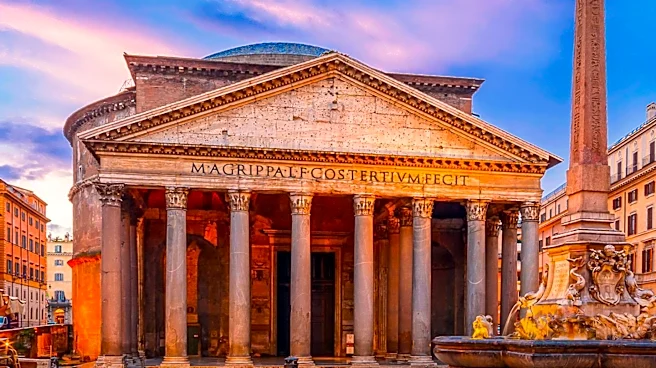




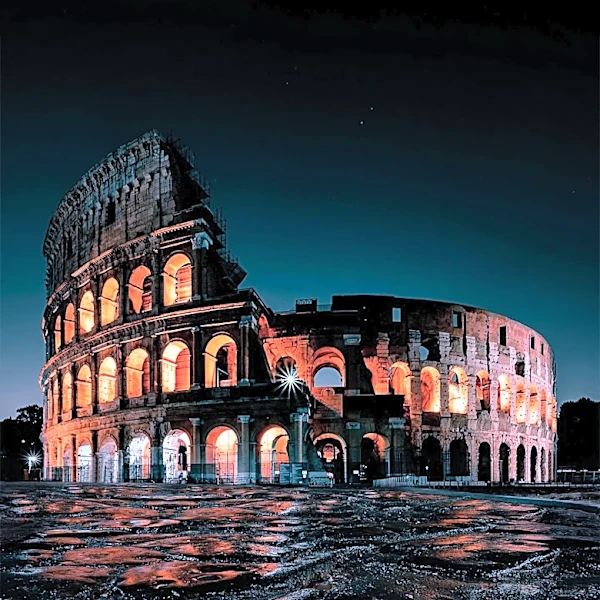



The Pantheon in Rome, Italy, stands as a remarkable testament to continuous use and architectural endurance. Originally conceived as a temple dedicated to all the gods of Ancient Rome, its history spans nearly two millennia, evolving from a pagan sanctuary to a Catholic church. This uninterrupted function has played a crucial role in its exceptional state of preservation, making it one of the best-preserved ancient Roman buildings. Its journey from a site
of polytheistic worship to a Christian basilica, known as Santa Maria ad Martyres, showcases a unique blend of cultural and religious adaptation over centuries.
Origins and Hadrian's Reconstruction
The current Pantheon was not the first structure on its site. An earlier temple, commissioned by Marcus Vipsanius Agrippa during the reign of Augustus, predated the existing edifice. This original structure, built around 27 BC, was later destroyed, likely by fire. The present building was then completed and probably dedicated around 126 AD during the reign of Emperor Hadrian. Interestingly, Hadrian chose to re-inscribe the new temple with Agrippa's original dedication, leading to some uncertainty about its precise construction date for a time. This act of re-inscription honored the original patron while marking the completion of a significantly redesigned and rebuilt structure.
Archaeological findings have shed light on the earlier Agrippan Pantheon. Excavations in the late 19th and late 20th centuries revealed details about its foundation and orientation. The Agrippan temple was built on an alluvial clay bank and featured a podium accessible by steps. Its orientation, facing north, was maintained in Hadrian's reconstruction, a significant detail given the ritual importance of sacred orientations in Roman architecture. The transition from Agrippa's design to Hadrian's involved a major architectural innovation: combining a classical temple portico with a large circular domed cella, a unique approach in Roman architecture of the time.
Transformation into a Christian Basilica
Since the 7th century, the Pantheon has served as a Catholic church, dedicated to St. Mary and the Martyrs, and is also known as "Santa Maria Rotonda." This conversion from a pagan temple to a Christian place of worship was pivotal in its preservation. Unlike many other ancient Roman structures that fell into ruin or were dismantled for their materials, the Pantheon's continuous religious function ensured its upkeep and protection. This dedication occurred on May 13, 609 AD, marking a new chapter in its long history.
The square in front of the Pantheon is still known as Piazza della Rotonda, reflecting its long-standing nickname. Today, the Pantheon is a state property, managed by Italy's Ministry of Cultural Heritage and Activities and Tourism. Its enduring presence as both a historical monument and an active place of worship underscores its unique status. The building's ability to adapt and remain relevant through changing eras, from the Roman Empire to the present day, highlights its profound cultural and architectural significance.
Enduring Influence and Modern Management
Beyond its religious and historical roles, the Pantheon has been enormously influential in Western architecture since the Renaissance. Its design, particularly its massive unreinforced concrete dome, served as an exemplar for countless later buildings. Architects like Brunelleschi, with his dome for Santa Maria del Fiore in Florence, and Gian Lorenzo Bernini, who restored the Roman original, drew inspiration from its innovative construction. Even structures like St. Hedwig's Cathedral in Berlin and Belle Isle House in England were consciously modeled after the Pantheon, demonstrating its lasting impact on architectural design across centuries and continents.
Its management today by the Italian Ministry of Cultural Heritage and Activities and Tourism ensures its continued preservation for future generations. The Pantheon remains a vibrant part of Rome's urban fabric, attracting visitors from around the world who come to marvel at its ancient engineering and rich history. Its journey from a temple of all gods to a church of martyrs, all while maintaining its structural integrity and architectural grandeur, is a testament to its timeless appeal.